
Advanced Micro Devices posted a record $13.4 billion in third-quarter revenue, positioning the semiconductor manufacturer to potentially eclipse rival Intel in quarterly sales for the first time in corporate history. The performance reflects a dramatic operational split inside the company, where explosive corporate demand for artificial intelligence hardware neutralized a collapse in console gaming chips. For institutional and retail technology portfolios across Canada, the results shift the focus from speculative promises to production delivery across hyperscale data networks.
What the Company Announced
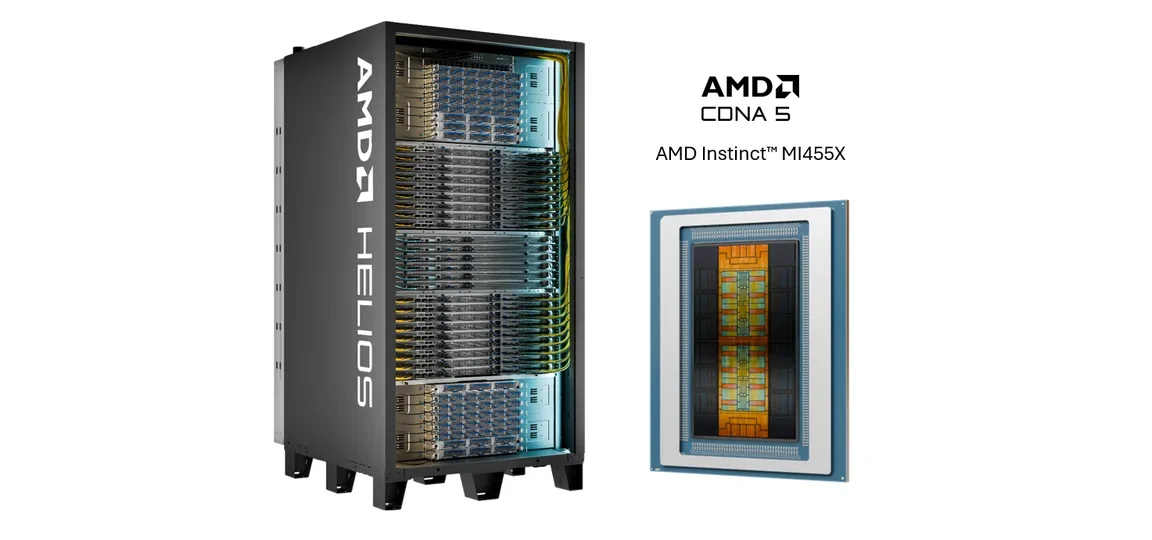
Advanced Micro Devices unveiled its third-quarter financial figures alongside aggressive revenue guidance for the final stretch of the fiscal year. Management confirmed that five major technology organizations—Meta Platforms, Microsoft, Oracle Cloud Infrastructure, OpenAI, and Anthropic—are actively deploying models and production workloads on AMD's Helios platform. The company also confirmed an expanded operational partnership with Meta Platforms and a strategic supply agreement with Anthropic.
Alongside organic product expansions, the enterprise disclosed definitive acquisition agreements for World Labs to bolster AI model research, as well as Taalas to secure specialized inference silicon technology.
We expect revenue to be approximately $17 billion, plus or minus 3%. The middle point of our guidance represents approximately 66% year-over-year revenue growth, primarily driven by the acceleration of our Data Center segment.
Key Financial Details
Total revenue climbed 44.6% year over year to approximately $13.4 billion, topping consensus projections by roughly 2%. The performance was anchored by the Data Center division, which expanded 97% year over year to generate a record $8.5 billion.

Profitability metrics demonstrated significant operating leverage across production lines:
- Operating income within the Data Center division surged 168% to reach $2.88 billion, lifting operating margins from 25% to 34%.
- Corporate adjusted operating income rose 75%, while adjusted net income grew 77%.
- Adjusted earnings per share climbed 74%, beating consensus expectations by about 8%.
- Client segment revenue, driven by Ryzen mobile chips, grew 7% to $2.95 billion.
- Embedded segment revenue reached $1.1 billion, up 29% on aerospace, defense, automotive, and industrial shipments.
- Gaming division revenue fell 40% to $773 million due to lower semi-custom console demand, shrinking to 5.8% of total company revenue.
Balance sheet reserves expanded as cash balances increased nearly 35% year-to-date, surpassing long-term debt liabilities. For the fourth quarter, AMD guided revenue to approximately $17 billion. Compared to Intel's concurrent fourth-quarter revenue guidance of $15 billion to $16 billion, meeting this midpoint would mark the first time AMD records higher quarterly revenue than Intel.
Why the Company Is Doing This
The strategic reallocation of engineering and manufacturing bandwidth toward enterprise servers stems from a structural transformation in computing architecture. Demand for AMD EPYC server central processing units and Instinct MI450 accelerator GPUs has accelerated as enterprise software shifts toward autonomous agentic workflows.
Management projects that server CPU infrastructure alone will represent a $220 billion addressable market by 2030. In agentic computing environments, orchestration needs are narrowing server balance ratios from between four and eight GPUs per CPU down toward nearly one GPU per CPU. Building full rack-scale systems through Helios allows the firm to capture system-level budgets rather than selling isolated processors.
Impact on Employees, Customers, and Investors
For enterprise cloud clients, AMD's capacity ramp offers a viable commercial alternative to single-vendor procurement risks. Running workloads across five hyperscale cloud environments confirms software portability, though competitive challenges persist. Morningstar senior analyst Brian Colello highlighted that Nvidia's integrated software tools remain a key competitive barrier that AMD must counter to expand its footprint.
For Canadian retail and institutional investors, AMD stock has gained approximately 170% in 2026, leaving shares trading near 60x consensus adjusted earnings. The post-earnings trading session exhibited elevated volatility: shares initially rallied as much as 7% before slipping 2.6% in morning trade amid broader tech weakness. Despite multiple-compression concerns, Morningstar raised its fair value estimate to $570 per share from $530, while Wall Street consensus price targets sit near $608, representing roughly 20% potential upside from pre-release levels.
Canadian consumers and PC device makers face headwinds from memory pricing. Escalating memory component expenses, cited by peer hardware executives, could constrain consumer PC manufacturing volumes through 2027, though AMD's exposure is cushioned by its enterprise mix.
What Comes Next
Management expects annual corporate revenue growth to exceed 80% heading into 2027, accompanied by ongoing operating margin expansion. Morningstar estimates that AMD's AI GPU revenue will grow from $7.4 billion in 2025 to nearly $17 billion in 2026, reaching approximately $43 billion in 2027 and $80 billion by 2030.
Closing timelines for the pending acquisitions of World Labs and Taalas remain focal points for integration over coming quarters. Meanwhile, delivery schedules for fourth-quarter Helios rack deployments will demonstrate whether AMD can hit its $17 billion target and finalize its historic revenue flip over Intel.
Frequently Asked Questions
- How much revenue did AMD generate in Q3?
- AMD reported third-quarter revenue of $13.4 billion, representing a 44.6% increase compared to the same period last year and surpassing market estimates by roughly 2%.
- Could AMD surpass Intel in total quarterly revenue?
- Yes. AMD guided fourth-quarter revenue to approximately $17 billion, while Intel projected fourth-quarter revenue between $15 billion and $16 billion. If both hit their guidance targets, AMD will surpass Intel in quarterly revenue for the first time.
- Why did AMD gaming revenue decline during the quarter?
- Gaming revenue dropped 40% year over year to $773 million due to lower demand for semi-custom console processors and gaming graphics chips, reducing gaming to 5.8% of AMD's total revenue.
- What major technology companies are using AMD Helios systems?
- Five enterprise customers are currently running models and workloads on AMD Helios systems: Meta Platforms, Microsoft, Oracle Cloud Infrastructure, OpenAI, and Anthropic.