
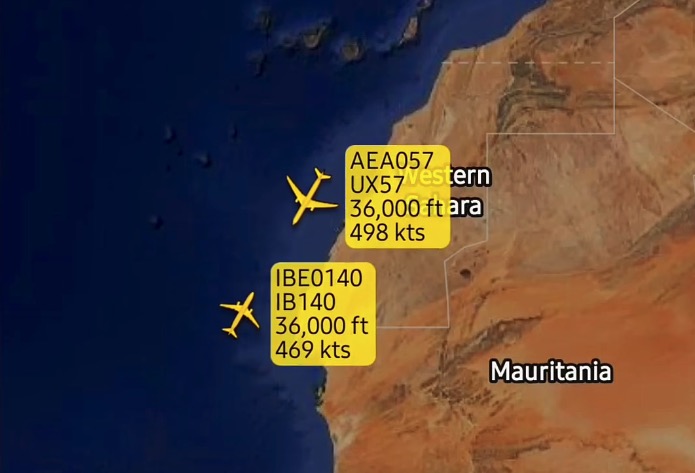
A staggering combined closing speed of 1,000 mph left two commercial airliners with just seconds to spare when they were cleared onto an identical mid-ocean flight path at the exact same altitude. The high-altitude emergency, which occurred in the pitch black of the early hours over the Atlantic, forced onboard safety systems to instantly override conventional air traffic management to prevent a major disaster. Investigators are now scrambling to discover how two packed passenger jets ended up hurtling directly toward one another on a single bidirectional airway.
The Bottom Line
- The incident occurred on July 10, 2026, at exactly 01:23 UTC on oceanic airway N857 between reporting points ETIBA and BIPET.
- A total of 454 passengers and 18 crew members were on board the two aircraft, with no injuries reported during the sudden maneuvers.
- Iberia flight IB140, an Airbus A321XLR, was flying northeast toward Madrid, while Air Europa flight UX57, a Boeing 787-9 Dreamliner, was heading southwest toward São Paulo.
- Both jets were mistakenly operating at Flight Level 360, placing them on a direct, head-on collision course at 36,000 feet.
- The disaster was entirely averted by the Traffic Alert and Collision Avoidance System (TCAS), which bypassed ground controllers to issue automatic escape commands.
Breaking It Down
The close call unfolded approximately 70 nautical miles off the coast of Western Sahara within the upper airspace managed by Spain's air navigation service provider, ENAIRE. Iberia flight IB140, a narrowbody Airbus A321XLR carrying passengers from Recife, Brazil, was cruising northeast toward Spain. At the exact same moment, Air Europa flight UX57, a widebody Boeing 787-9 Dreamliner, was tracking southwest from Madrid toward São Paulo, Brazil. Both aircraft had reportedly been cleared by air traffic control to maintain an identical altitude, completely compromising standard oceanic separation rules.
As the distance between the two jets rapidly dissolved at a closing rate of nearly 1,000 mph, the ultimate airborne safety net fired on both flight decks. The onboard transponders automatically cross-communicated to generate instant, complementary vertical escape maneuvers. Bypassing ground instructions entirely, the Iberia Airbus received a strict "TCAS RA DESCEND" order, prompting the crew to dive approximately 500 feet. Simultaneously on the opposing flight deck, the Air Europa Boeing was instructed to "TCAS RA CLIMB," initiating a rapid 400-foot ascent.

The sudden, dramatic altitude adjustments would have been instantly noticeable to the passengers resting in the cabins, though both flights successfully restored safe vertical separation. Once the automated transponders confirmed the danger had passed, a "CLEAR OF CONFLICT" notification appeared on the pilots' screens. The Air Europa flight continued directly to South America, while the Iberia crew executed a series of altitude corrections—climbing to 35,000 feet, then 37,000 feet, and eventually 38,000 feet—before landing safely at Madrid airport.
Why This Matters
This serious loss of separation highlights a profound failure in the standard procedural safeguards that manage international flights. In high-density continental airspace, aircraft are constantly tracked by continuous ground radar. However, large oceanic sectors like the Canary Islands Oceanic Flight Information Region rely heavily on a combination of satellite surveillance, procedural control, and strict altitude formatting. Westbound traffic is traditionally assigned even flight levels like 36,000 feet, whereas eastbound flights take odd levels, making the presence of the eastbound Iberia jet at an even altitude a critical breakdown in the safety chain.
For travelers in the UK and globally, the incident serves as a stark reminder of why safety regulations exist, particularly the requirement to keep seatbelts fastened even during calm cruising phases. Sudden TCAS resolution advisories require immediate, aggressive physical pilot intervention to change altitude, which can cause abrupt cabin movements and severe injuries to unbuckled passengers. While these events are incredibly rare, the successful resolution of this conflict proves why independent, automated redundancy remains the backbone of modern aviation technology.
- TCAS
- Traffic Alert and Collision Avoidance System; an independent onboard system that monitors surrounding airspace via transponders and issues emergency flight path adjustments.
- Resolution Advisory (RA)
- A critical automated instruction issued by TCAS that orders pilots to immediately climb or descend to avoid an imminent mid-air collision.
- Flight Level (FL)
- A standard altimeter setting used in aviation to describe an aircraft's altitude in hundreds of feet; for example, FL360 represents 36,000 feet.
What Comes Next
Spain's Civil Aviation Accident and Incident Investigation Commission (CIAIAC) has launched a formal technical probe alongside Spain’s Independent Professional Union of Air Traffic Controllers (SPICA). The official investigation will meticulously review the sequence of oceanic clearances, air traffic control audio logs, sector coordination procedures, and the flight data recorders from both aircraft to pinpoint exactly where the operational breakdown occurred. Investigators will also determine whether either crew had implemented a Strategic Lateral Offset Procedure—a safety method allowing pilots to fly up to two miles to the right of an airway to create a lateral buffer zone.
Frequently Asked Questions
How close did the Iberia and Air Europa planes actually come?
Preliminary flight data indicates the two aircraft came within less than 2 nautical miles of each other horizontally before the emergency maneuvers were executed. Speculative reports suggesting they came within three meters of each other have been strongly questioned by aviation experts, as a head-on closure at that proximity would have resulted in an impact within thousandths of a second.
Why didn't air traffic controllers stop the aircraft from getting so close?
The incident took place in oceanic airspace outside traditional continental radar coverage, where controllers rely on procedural separation and coordinated position reports. The investigation is currently analyzing whether the conflict was caused by an air traffic control communication error, a pilot altitude mistake, or a systemic coordination breakdown between flight sectors.
Are pilots allowed to ignore air traffic control during a TCAS alert?
Yes. International aviation regulations mandate that automated TCAS Resolution Advisories take absolute precedence over any ground-based air traffic control instructions. Pilots are trained to instantly comply with the cockpit's automated climb or descent commands without waiting for clearance from controllers.