
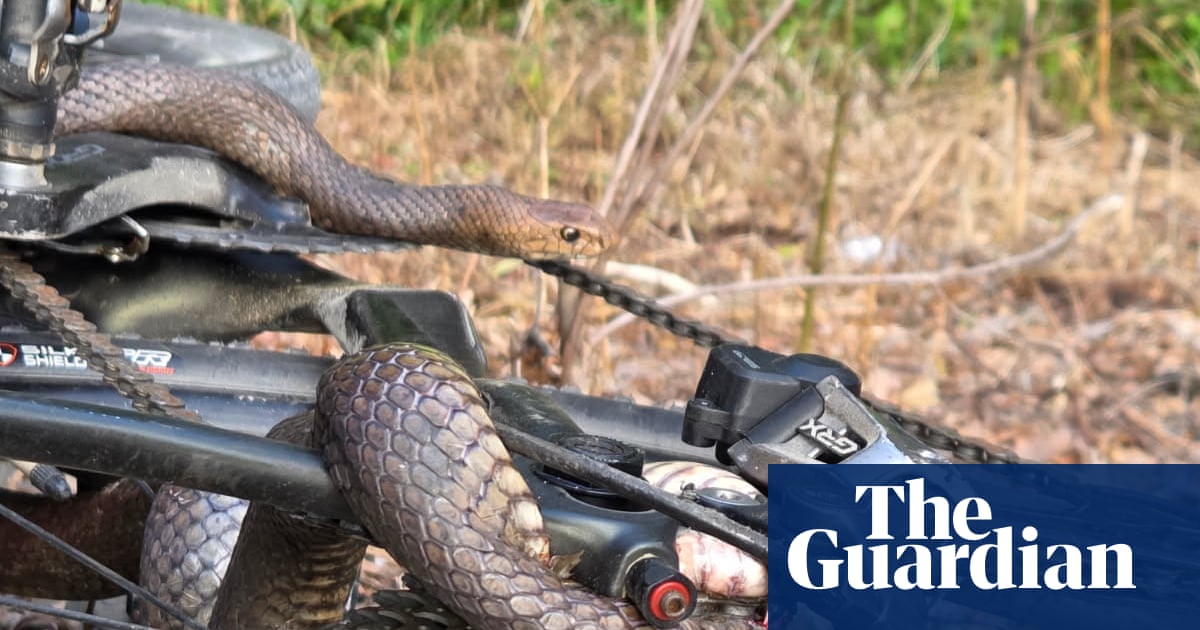
A two-metre-long eastern brown snake — the world's second most venomous land snake — became tightly entangled in a holidaymaker's bicycle chain before biting her thigh in a freak accident on a popular New South Wales trail. The woman in her 60s was enjoying a final ride on the Northern Rivers Rail Trail near Burringbar on Wednesday when she ran over the reptile, sparking a highly dangerous rescue effort. Miraculously, she escaped with a "dry bite" and was discharged from hospital on Thursday morning, just ahead of World Snake Day.
The Bottom Line
- A woman in her 60s was riding on the Northern Rivers Rail Trail near Burringbar on Wednesday when she ran over a large eastern brown snake.
- The reptile became trapped in her bike chain and bit her thigh, but fortunately delivered a "dry bite" containing no venom.
- Emergency services and NSW Police assisted local snake catcher Sarah Mailey in a tense, complex operation to restrain the snake and dismantle the bicycle.
- The woman was monitored overnight at Tweed Valley Hospital and was safely discharged on Thursday morning.
- The two-metre snake suffered severe internal injuries to its vital organs and had to be euthanised.
Breaking It Down
The incident unfolded around 1:00 pm on Wednesday when the cyclist, on the final day of her holiday, was riding near Upper Burringbar Road in the Tweed Shire. She ran over the snake, which was resting on the path. The impact instantly jammed the lower half of the two-metre reptile's body deep into the bicycle's chain mechanism, trapping it against the frame. Terrified and thrashing, the snake struck the woman's thigh.
NSW Ambulance paramedics rushed to the scene and called in local snake catcher Sarah Mailey from I’ll Catch It Snake Relocations. Mailey faced an incredibly volatile rescue environment. While the snake's mid-section was pinned tight, its upper body and head were completely free, highly active, and swinging around ready to strike again.
Its head wasn’t in the chain so it was free to be able to strike her leg.
While bystanders and NSW Police officers worked to unscrew and dismantle the bike's chain and components, Mailey had to physically pin and hold the snake's head to prevent further attacks. Once freed, the reptile was rushed to a nearby wildlife hospital. However, veterinary staff discovered it had sustained catastrophic mid-body trauma to its vital organs and was in severe pain, leaving them no choice but to euthanise the animal.
Why This Matters
While cyclists colliding with snakes is not entirely uncommon in regional Australia, having one wrap itself into a moving bike chain is an extraordinarily rare mishap. Mailey, who consulted a colleague with 31 years of experience, confirmed that while similar incidents have occurred a handful of times, it was a first in her career. The snake's inability to dodge the bicycle was likely exacerbated by a pre-existing injury: the eastern brown was blind in its left eye, meaning it could not see the approaching shadow and was forced to rely solely on ground vibrations.
Eastern brown snakes are highly venomous, and their bites can be fatal within hours as the venom attacks both the nervous system and blood clotting. A dry bite — where the snake defends itself without injecting venom — is incredibly lucky. However, medical staff at Tweed Valley Hospital kept the cyclist overnight because symptoms can sometimes be heavily delayed, and patients are never considered out of danger until extended observation is complete.
This close call serves as a major warning for outdoor enthusiasts in Australia. The Northern Rivers Rail Trail cuts directly through native bushland and active farmland. As Mailey pointed out, snakes are attracted to the concrete trail because of the warm sun and the small burrows and rodents that live directly underneath the path's edge. It is their natural habitat, meaning trail users must actively prepare for encounters.
What Comes Next
With trail traffic remaining high, local authorities and wildlife experts are reminding the public of critical safety protocols. Cyclists and walkers should always carry specialized compression bandages when hitting regional trails. If you spot a snake on the path, stop at a safe distance and wait for it to pass. If the snake remains stationary, step off your bike and walk as far around the animal as physically possible to avoid triggering a defensive strike.
FAQ
How did the snake get caught in the bike chain?
The cyclist accidentally ran over the two-metre eastern brown snake while riding. The collision caused the snake's lower body to get caught and wedged tightly in the bicycle's chain and wheel mechanism.
Why didn't the snake move out of the way of the bicycle?
The snake was blind in its left eye, which severely limited its vision. Combined with cooler seasonal weather that slows reptile reflexes, the snake did not see the bike approaching in time to slither away.
What is a dry bite, and is it common?
A dry bite occurs when a venomous snake bites a person but does not release any venom. While it is a lucky outcome, anyone bitten must still receive immediate emergency medical care, as venom delivery cannot be confirmed without hospital monitoring.
What should you do if you encounter a snake on a trail?
Stop immediately and maintain your distance. Wait for the snake to move off the path on its own. If it refuses to budge, dismount from your bicycle and walk around it, leaving the widest possible gap between you and the reptile.