
A cloud of traditional smoke drifted across the red dirt of Central Australia as Arrernte traditional owners welcomed hundreds of activists to the desert. The solemn ceremony marked the beginning of a major three-day convergence aimed directly at Australia's most secretive intelligence facility. More than 500 activists, First Nations leaders, and academics have descended on Alice Springs to demand the immediate shutdown of the Joint Defence Facility Pine Gap.
How Events Unfolded
The three-day gathering, dubbed the "Close Pine Gap - Sacred Land Back" convergence, marks the 60th anniversary of the initial 1966 agreement between Canberra and Washington that established the base. Activists from across the country, including Palestine solidarity groups and anti-AUKUS campaigners, travelled thousands of kilometres to converge at a desert research institute just outside Alice Springs. Unlike historic demonstrations, tight security measures now prevent protesters from approaching the facility's perimeter gates.
Veterans of the movement recalled how the landscape of dissent has changed. Protesters Lies and Els Paijmans, who travelled from regional New South Wales, previously attended the famous Women for Survival camp at the site in 1983. Back then, a crowd of 800 women successfully pushed down the gates to hold a symbolic tea party on the base grounds, resulting in roughly 100 arrests. Today, federal police presence and advanced surveillance networks keep the crowds physically separated from the installation.
Organiser Nathalie Farah stated that the modern crowd is driven by deep frustration and grief regarding Australia's foreign policy alignments. Demonstrators plan to maintain a peaceful but highly visible presence throughout the weekend to signal structural opposition to Australia's deepening military ties with the United States. Meanwhile, the Department of Defence has maintained its standard silence, stating that the government does not comment on intelligence matters or the operation of joint facilities.
Digging Deeper
Pine Gap was originally sold to the Australian public in the 1960s as a benign space research base. Over six decades, it has evolved into a massive, heavily restricted intelligence and surveillance hub dominated by distinct, golf-ball-like radomes. The facility serves as a primary ground station for US satellites parked in high orbit, plucking faint signals from foreign military communications, radar installations, and missile tests.
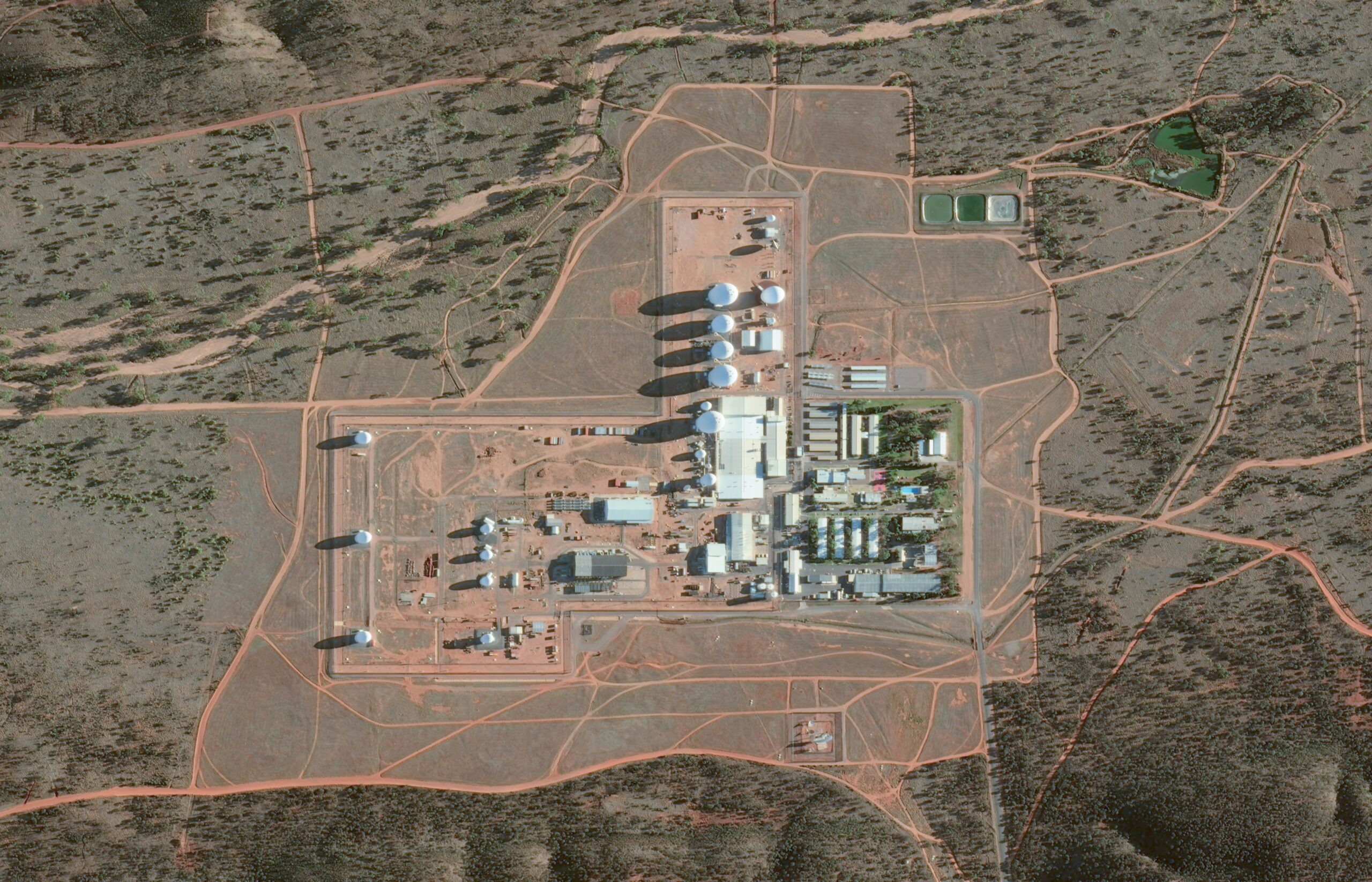
However, recent structural analysis suggests the strategic leverage Australia gains from hosting the base may be shifting. Historically, the isolated location 18 kilometres south-west of Alice Springs provided unparalleled security, making the satellite downlinks impossible for foreign adversaries to intercept without physical proximity. In the modern era, advanced encryption protocols mean data streams can be secured anywhere, reducing the absolute necessity of the remote desert location. Furthermore, commercial satellite imagery and the rise of network-based cyber collection have narrowed the unique advantages Pine Gap once offered to the alliance.
What People Are Saying
The protest has amplified long-standing grievances held by the traditional custodians of the land. The base sits directly on Arrernte ancestral country, completely cutting off access to recognized sacred sites and ancient rock art galleries located within the high-security fencing.
We don't want to be feeling guilty all the time when bad things are happening overseas to little ones. We're not the ones controlling that facility, but we feel guilty that it's coming from our land.
Prominent researchers have also raised concerns regarding how the facility's intelligence output connects Australia to international conflicts. Critics argue that real-time data collected by the base compromises Australia's independent foreign standing.
Unless the Australian direct and indirect military relationship to Israeli activities in the Gaza Strip are closely reviewed … it is not possible for the Australian government to assure the parliament and Australian public that Australia is not complicit in acts of genocide.
Putting It in Perspective
The convergence highlights a stark socio-economic contrast playing out in the red centre. While the multi-billion-dollar intelligence hub enjoys state-of-the-art power, security, and communications infrastructure, the traditional owners who claim the land live in critical poverty nearby. Many senior custodians reside at the Irrkerlantye/Whitegate town camp, situated just five kilometres from the centre of Alice Springs.
Residents at the Whitegate community live in makeshift cabins and tents without access to a basic sewerage system or grid electricity. Drinking water must be trucked into the site manually, and power is generated by a small, insufficient array of solar panels. William Tilmouth, a senior Arrernte man, noted that the community is fighting a fundamental battle for basic human justice, seeking the same standard amenities that the rest of the Australian public takes for granted.
Looking Ahead
The three-day protest will conclude with formal declarations from First Nations leaders and anti-war coalitions demanding a thorough review of joint facility agreements. Traditional owners have confirmed they will continue to petition the federal government for formal land compensation and the immediate provision of permanent housing at the Whitegate community. Despite the mounting domestic pressure, the fundamental operations of the base remain locked behind strict secrecy protocols, with no policy alterations indicated by either Canberra or Washington.
Frequently Asked Questions
What is Pine Gap?
Pine Gap is a joint Australian-American military satellite surveillance base located 18 kilometres south-west of Alice Springs in the Northern Territory. It monitors global communications, radar systems, and missile data.
Why are people protesting at the site today?
Protesters have gathered to mark the 60th anniversary of the base treaty, demanding its closure due to concerns over Australian complicity in foreign military conflicts and the ongoing denial of land rights to traditional owners.
How does the base affect the local Arrernte people?
The facility occupies sacred ancestral land, blocking traditional owners from accessing key cultural sites and rock art galleries. Meanwhile, many local custodians live nearby without basic amenities like running water or sewerage.
What is the Australian government's position on the protests?
The Department of Defence maintains a strict policy of not commenting on intelligence matters or the operational specifics of joint military facilities.