
A major food safety investigation has revealed that several popular rice products on supermarket shelves contain concerning levels of inorganic arsenic, a dangerous heavy metal and known carcinogen. For families across Canada who rely on rice as a daily dinner staple, the findings highlight a persistent, unaddressed risk in the food supply. New laboratory testing has detected measurable levels of toxic inorganic compounds in every single rice sample analyzed, prompting renewed calls for federal intervention.
The Backstory
Arsenic is a naturally occurring element found within the Earth's crust, but its high concentration in agricultural soil and water is primarily a legacy of industrial manufacturing and historical pesticide use. Throughout the 20th century, arsenic-based pesticides were heavily sprayed on orchards and cotton fields. Although many of these chemicals were banned in the 1980s, their toxic residues linger in the environment for decades, continuously seeping into local water tables and agricultural land.
While heavy metal contamination affects various crops, rice possesses a unique biology that makes it ten times more susceptible to picking up arsenic than other grains. Rice is traditionally cultivated in heavily irrigated, flooded paddies. This flooded environment triggers a chemical reaction in the soil that releases bound arsenic into the water, allowing it to be easily absorbed by the plant's roots. Furthermore, rice is a silicon hyperaccumulator; it naturally draws silicon from the ground to build strength, but because arsenic shares a nearly identical chemical structure, the plant mistakenly absorbs the toxin through the exact same biological pathways.
Compounding the problem, recent academic modeling suggests climate change is poised to exacerbate this food safety issue. A study published in the journal Lancet Planetary Health demonstrated that rice cultivated in hotter temperatures with elevated carbon dioxide levels absorbs significantly higher concentrations of inorganic arsenic, potentially triggering millions of additional cancer cases globally by 2050.
Here's What Happened
In a comprehensive market sweep, researchers from Consumer Reports executed a spot check of the market by testing total and inorganic arsenic levels across 52 different rice products, including arborio, basmati, brown, jasmine, sushi, and precooked microwavable varieties. Simultaneously, a separate consumer study conducted by the advocacy group Mamavation sent 56 popular rice and rice noodle products to an independent, EPA-certified laboratory. The dual investigations yielded alarming results: 100% of the tested rice samples contained detectable total arsenic.
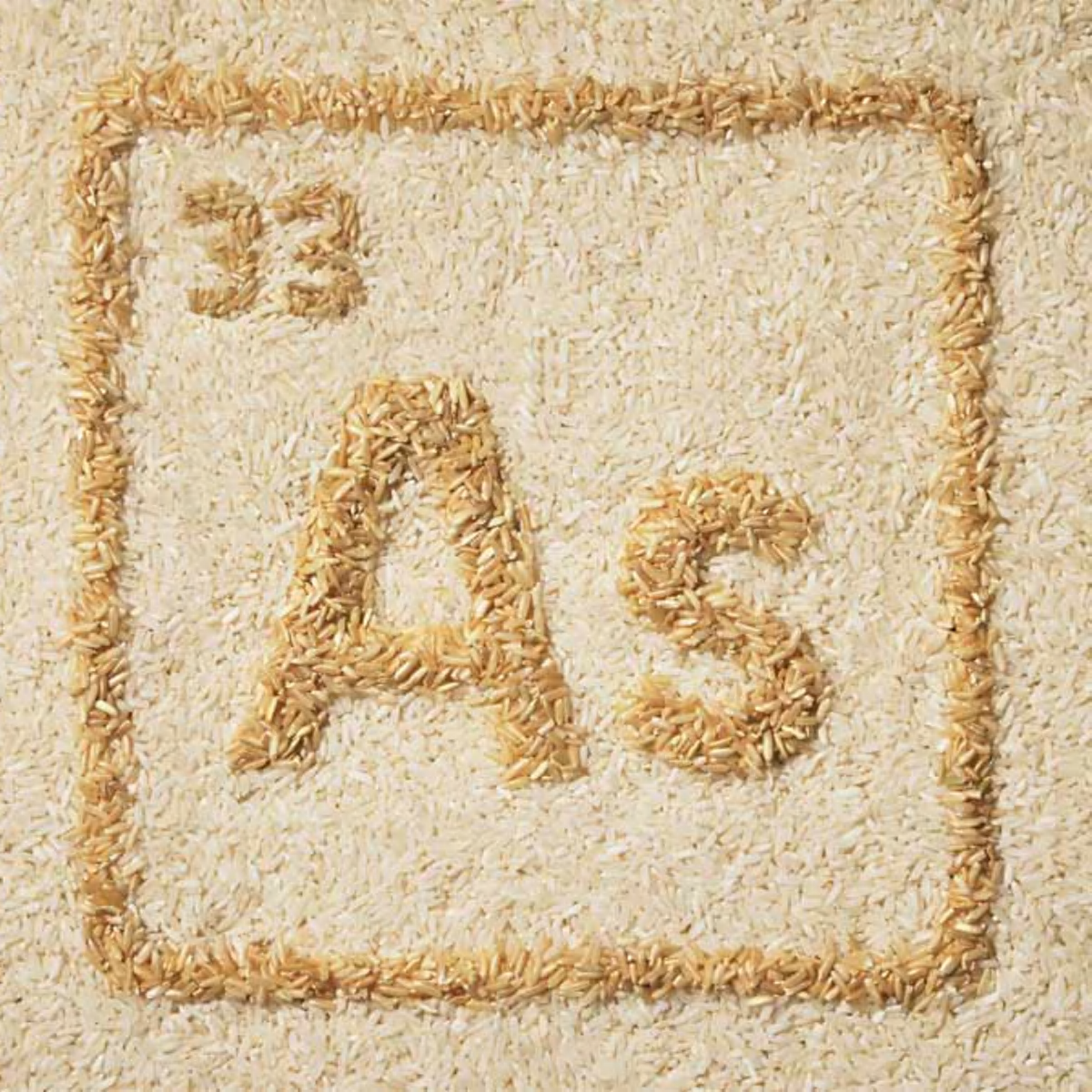
The testing demonstrated that arsenic levels vary dramatically depending on the specific grain type and geography. Brown rice consistently exhibited the highest contamination, averaging 113 ppb (parts per billion) of inorganic arsenic, compared to an average of 72 ppb for white rice. Because arsenic concentrates heavily in the outer bran layer, whole-grain brown rice retains the toxin, whereas the commercial polishing process used to make white rice strips the outer layers away, lowering the total heavy metal content. The highest-scaling samples in the Mamavation study originated from Louisiana, Texas, South Carolina, and China, reaching up to 222 ppb of inorganic arsenic.
Conversely, white basmati and sushi rice varieties scored the lowest average inorganic arsenic levels, hovering between 32 ppb and 57 ppb. The lowest overall concentrations were consistently tied to crops cultivated in California, India, and Thailand. Alarmingly, the investigation also discovered that packaged rice side dishes utilizing pre-blended seasoning packets—such as Ben's Original Long Grain & Wild Rice, which averaged 167 ppb—frequently contained elevated levels of lead, which researchers tracked back to heavy metal concentration in imported spices.
What People Are Saying
The persistent presence of these toxins has drawn fierce criticism from environmental medical professionals and food policy advocates, who argue that public safety is being compromised by a lack of strict regulatory standards. Currently, there are no federal arsenic limits for general rice products in North America, leaving consumers entirely unshielded from long-term exposure.
In 42 percent of the products, the average inorganic arsenic levels were high enough that an adult eating just one serving a day over time would have a significantly increased risk for skin cancer, bladder cancer, and type 2 diabetes.
Public health experts are particularly protective of young children, who face heightened neurological risks due to their lower body weights. Because their developing systems are exceptionally vulnerable to heavy metals, the lack of labeling or warnings remains a critical point of contention.
Pay close attention to how much arsenic is in your rice if you are raising young children or are pregnant. This is a big problem for women who are pregnant, feeding small children, and people who consume lots of rice.
The Bigger Picture
While the immediate findings are troubling, health authorities emphasize that consumers should not panic, as the health risks associated with inorganic arsenic are cumulative and develop from steady exposure over decades. However, because rice accounts for roughly 17% of the average total dietary exposure to inorganic arsenic, modifying kitchen habits can drastically diminish long-term health risks. Epidemiological data indicates that individuals consuming just one serving of rice daily show a 44% increase in excreted urinary arsenic levels compared to those who eat none.
Families looking to reduce their intake can adopt a specialized cooking hack vetted by researchers at the University of Sheffield and Consumer Reports. Dubbed the parboiling with absorption method, it requires home cooks to add rice to pre-boiled water, boil it rapidly for 5 minutes, drain away the arsenic-laden water completely, and then finish cooking the grain on low heat with fresh water. Testing confirms this technique eliminates up to 58% of inorganic arsenic from white rice and over 50% from brown rice without degrading vital micronutrients.
Furthermore, shifting your dietary patterns to rotate in alternative ancient grains provides a robust nutritional safety net. Laboratory testing on ten alternative grains—including farro, quinoa, barley, millet, and sorghum—revealed that even the grain with the highest trace arsenic (oats) contained less than a quarter of the heavy metals found in the cleanest sushi rice on the market.
The Road Ahead
In response to the data, advocacy groups are actively petitioning the Food and Drug Administration and health regulators to establish mandatory statutory limits on all commercial rice products. While the agency previously instituted a strict 100 ppb action level for infant rice cereals—which successfully forced a 40% market drop in infant cereal arsenic levels over subsequent years—it has yet to provide a timeline or commitment for protecting the broader public food supply.
Meanwhile, agricultural bodies are exploring long-term field mitigations. The U.S. Rice Federation confirmed that agronomic techniques are currently being trialed across major growing regions, including furrow-irrigating crops rather than completely submerging fields, an alternative practice that currently protects approximately 20% of the rice acreage in Arkansas from excessive heavy metal uptake.
Frequently Asked Questions
Why does rice contain higher levels of arsenic than other grains?
Rice has a unique biological structure and is primarily grown in flooded paddies. The flooded conditions cause the soil to release toxic inorganic arsenic into the water supply, where it is readily absorbed by the roots. Because arsenic structurally mimics silicon—a mineral that rice hyperaccumulates to grow—the plant actively pulls the heavy metal into its grain at ten times the rate of other crops.
Does brown rice have more arsenic than white rice?
Yes, brown rice consistently contains higher levels of inorganic arsenic than white rice, averaging 113 ppb compared to white rice's 72 ppb. Arsenic heavily accumulates in the grain's outer bran layer. When white rice is manufactured, it undergoes a commercial polishing process that removes this outer hull, subsequently removing a significant portion of the heavy metal contaminants.
What is the most effective way to cook rice to remove arsenic?
The most effective method is the parboiling with absorption technique. You add the rice to boiling water, cook it for 5 minutes, drain the water completely to discard the leached toxins, and then add fresh water to finish cooking the rice on low heat. This method has been proven to remove up to 58% of inorganic arsenic from white rice and 50% from brown rice.
Which types of rice are safest and have the lowest arsenic levels?
White basmati rice imported from India or Pakistan, white basmati grown in California, and white sushi rice consistently show the lowest average levels of inorganic arsenic, typically ranging from 32 to 57 ppb. For those who strictly prefer brown rice, choosing a basmati brown variety provides a lower-risk option than standard long-grain brown rice.