
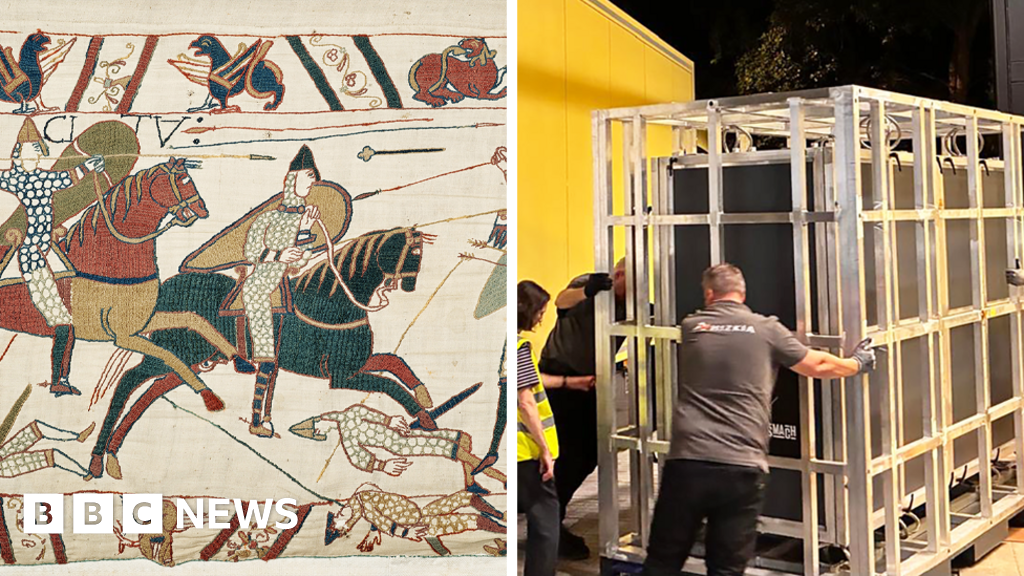
In the middle of the night, a large crate rolled through quiet London streets under police escort and backed into the British Museum. Inside was the Bayeux Tapestry, a nearly 1,000-year-old embroidery making its first return to Britain in centuries. The 70-metre-long work arrived after an 11-hour journey from France and is now being prepared for a major exhibition opening in September.
How Events Unfolded
The transfer was carried out with unusual secrecy because of the age, fragility and cultural importance of the work. According to the BBC account of the arrival, the crate reached the museum loading bay at about 2:50 a.m. after travelling from a secret location in northern France.
The embroidery crossed the Channel through the Eurotunnel before continuing by truck to central London. The Metropolitan and Kent police forces escorted the shipment, while the transport system itself had been tested in advance using a textile copy. Two practice journeys were used to measure vibration and identify ways to reduce shocks from the road.
The artwork was kept on a folding support, placed in a climate-controlled case and then secured inside an outer structure fitted with metal springs. Those layers were designed to limit sudden movement and protect the work from changes in temperature and humidity.
After the truck backed into the museum, the container was slowly lowered to the ground as museum staff and British and French representatives watched. The work will now spend time acclimatising before curators unpack it and begin detailed condition checks.
The Fine Print
Despite its familiar name, the Bayeux Tapestry is not technically a tapestry. It is an embroidery made from coloured wool stitched onto linen. Across 58 scenes, it depicts events leading to the Battle of Hastings and the Norman Conquest of England in 1066.
The surviving object contains 626 characters, 202 horses and numerous ships, weapons and scenes of daily medieval life. Its images provide evidence about armour, architecture and seafaring that written accounts cannot show in the same way.

The loan became possible while the museum in Bayeux, Normandy, is closed for renovation. The agreement is backed by the French government, while the British Museum will send objects to France in return, including treasures from the Sutton Hoo hoard and the Lewis chess pieces.
The Response
British Museum director Nicholas Cullinan described the arrival as the result of a major effort involving teams in both countries.
We've just witnessed something rather extraordinary, which is the arrival of the Bayeux Tapestry at the British Museum but specifically it is returning to England for the first time in almost 1,000 years.
French President Emmanuel Macron framed the loan as more than a museum exchange. In comments reported by several of the provided sources, he called it a gesture of trust and a sign of the relationship between France and the United Kingdom.
Not everyone supported moving the embroidery. A French petition described the loan as a heritage crime, while artist David Hockney had argued before his death that such a fragile object should not be exposed to the risk of travel. Museum officials responded that the transport would not have gone ahead if lenders or specialists believed the work could not be moved safely.
Putting It in Perspective
The arrival matters because the embroidery has survived more than nine centuries despite threats including damp, fire, mould, moths and physical wear. It also records one of the most consequential political changes in English history, when Norman rule replaced the Anglo-Saxon order and reshaped land ownership, the church and the country's links to continental Europe.

The public response has already been substantial. The British Museum sold about 100,000 tickets on the first day, while CNN reported more than £2.4 million in sales during the first 24 hours. The Guardian reported that about 7.5 million people are expected to see the work during its London stay.
For Canadian readers, the exhibition is a major international cultural event rather than a local one. The scale of the public demand and the unusual security operation show how a medieval textile can still command the attention usually associated with modern blockbuster exhibitions.
Looking Ahead
Curators will spend the coming weeks examining the embroidery after its journey and preparing a custom display. The work must be shown flat under the terms of the loan, and a mezzanine will allow visitors to view its full length as they enter the gallery.
The exhibition is scheduled to open at the British Museum in September and continue until July 2027, after which the embroidery is expected to return to Bayeux when its museum reopens following renovation.
Frequently Asked Questions
Where is the Bayeux Tapestry now?
It is at the British Museum in London after an overnight journey from France. Curators are carrying out condition checks before the exhibition opens.
When will the Bayeux Tapestry go on display?
The British Museum exhibition is due to open in September. The work is expected to remain in London until July 2027.
How long is the Bayeux Tapestry?
The embroidery is about 70 metres, or roughly 230 feet, long. It tells its story through 58 scenes.
Why was the Bayeux Tapestry moved at night?
The transfer involved tight security and detailed planning because the object is nearly 1,000 years old and extremely valuable. Police escorted the truck as it travelled from France to London.
Is the Bayeux Tapestry really a tapestry?
No. It is an embroidery made from coloured wool stitched onto linen, rather than an image woven into fabric.
Why is the Bayeux Tapestry being loaned to Britain?
The museum that normally houses it in Bayeux is closed for renovation. The loan is part of a cultural exchange backed by the French and British sides.