
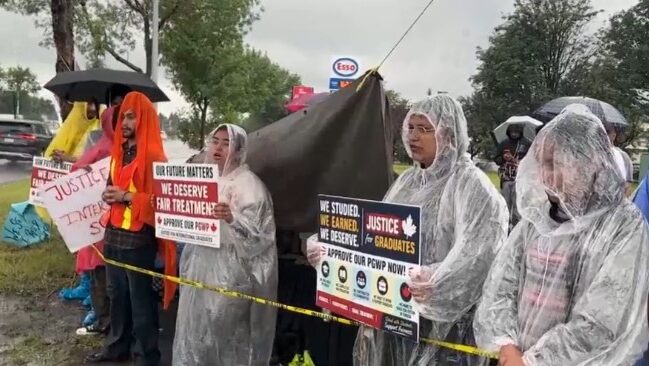
Outside college campuses and government offices in Alberta, international graduates have spent days standing in heavy rain and holding signs demanding answers. Many who completed two-year programs now find their applications for open work permits unexpectedly rejected. The widespread refusals mark a dramatic turning point in Canada's international student system, leaving hundreds of recent graduates facing tight deadlines to maintain their legal status or leave the country.
What Is Happening
Hundreds of international graduates across Alberta are receiving refusal letters from Immigration, Refugees and Citizenship Canada (IRCC) for their Post-Graduation Work Permit (PGWP) applications. Protests have erupted at the College Institute of Osteopathic Therapy (CIOT) near Saddletowne Circle in Calgary and along 50 Street in Edmonton's Mill Woods neighborhood, where students completed programs offered through partnerships with public institutions like Portage College. Affected graduates report that despite completing their studies and meeting language requirements, IRCC is denying permits on the grounds that their completed programs were non-credit.
The Background
For years, Canada served as a top destination for international students, largely due to straightforward pathways from study permits to post-graduate work authorization and eventual permanent residency. However, federal officials have increasingly moved to curb growth in temporary resident numbers and address system integrity. Internal government communications show that Ottawa has been tracking integrity concerns, including instances where individuals arranged marriages of convenience advertised in newspapers and on dating apps to obtain spousal open work permits.

To address these issues, the federal government systematically tightened rules. In January 2024, Ottawa ended most spousal open work permits for undergraduate students, and in early 2025, restricted them further to spouses of students in master's programs lasting 16 months or longer, doctoral studies, or select professional degrees. Additionally, in April 2024, IRCC announced that students starting public-private curriculum licensing arrangements on or after May 15, 2024, would be ineligible for PGWPs.
The Latest Development
The sudden surge in refusals follows an online guidance update by IRCC in June 2026 clarifying eligibility requirements for non-credit studies. IRCC maintains that to qualify for a PGWP, applicants must complete a program of study that leads to a degree, diploma, or certificate from a Designated Learning Institution (DLI), excluding general interest, language, and non-credit courses. While federal officials state this is a longstanding requirement rather than a policy change, protesting students point out that classmates in the exact same programs previously received approvals, while others are now being systematically turned down.

The impact of policy tightening is evident in federal application numbers. IRCC figures reveal that the total number of Indian study permit holders dropped from 277,950 in 2023 to 188,125 in 2024, falling further to 93,840 in 2025. Meanwhile, processing times for standard study permit applications from India currently run 8 to 12 weeks, with out-of-country work permit processing times averaging 9 weeks.
What It Means
For international graduates in Canada, a work permit denial creates immediate legal and financial pressure. Former students have a strictly enforced 90-day window to restore their legal status, change their visa category, or leave the country. Graduates seeking judicial review of an IRCC decision face a tight deadline of just 15 days from receiving a refusal letter to file an application in court. Many affected individuals report having paid tuition fees ranging between $32,000 and $40,000, leaving them with substantial debt and no clear pathway to gain Canadian work experience.
What Remains Unclear
Considerable uncertainty remains over why students enrolled in identical courses at the same institutions are receiving conflicting outcomes, with some granted work permits while others are issued refusals. Colleges such as Portage College have stated they are actively seeking clarification from federal authorities, while IRCC maintains that each application is assessed on its individual merits under the Immigration and Refugee Protection Act. It also remains unclear whether federal officials will offer any administrative remedy or reconsideration framework for students who enrolled prior to recent guidance updates.
Frequently Asked Questions
Why are international students being denied Post-Graduation Work Permits?
IRCC is enforcing eligibility criteria that require programs to lead to a degree, diploma, or certificate directly from a Designated Learning Institution, excluding non-credit programs and certain public-private licensing arrangements.
How long do students have to take action after receiving a refusal?
Graduates have a 90-day window to maintain or restore legal status in Canada, and a 15-day deadline from the date of refusal to file for judicial review.
What are the current processing times for Canada study permits from India?
Standard study permit applications from India currently take 8 to 12 weeks to process, while Student Direct Stream (SDS) applications can be processed in as few as 20 days.
Can international students work off-campus while studying?
Eligible international students whose study permit conditions permit off-campus work are limited to working a maximum of 24 hours per week while regular academic classes are in session.
Are spouses of undergraduate international students eligible for work permits?
No, open work permits for spouses are now restricted to partners of students enrolled in master's programs lasting 16 months or longer, doctoral studies, or specified professional programs.
What happens if a foreign national works in Canada without authorization?
Working without proper authorization can lead to severe penalties, including removal orders, a five-year ban on re-entering Canada, and a permanent fraud flag on immigration records.