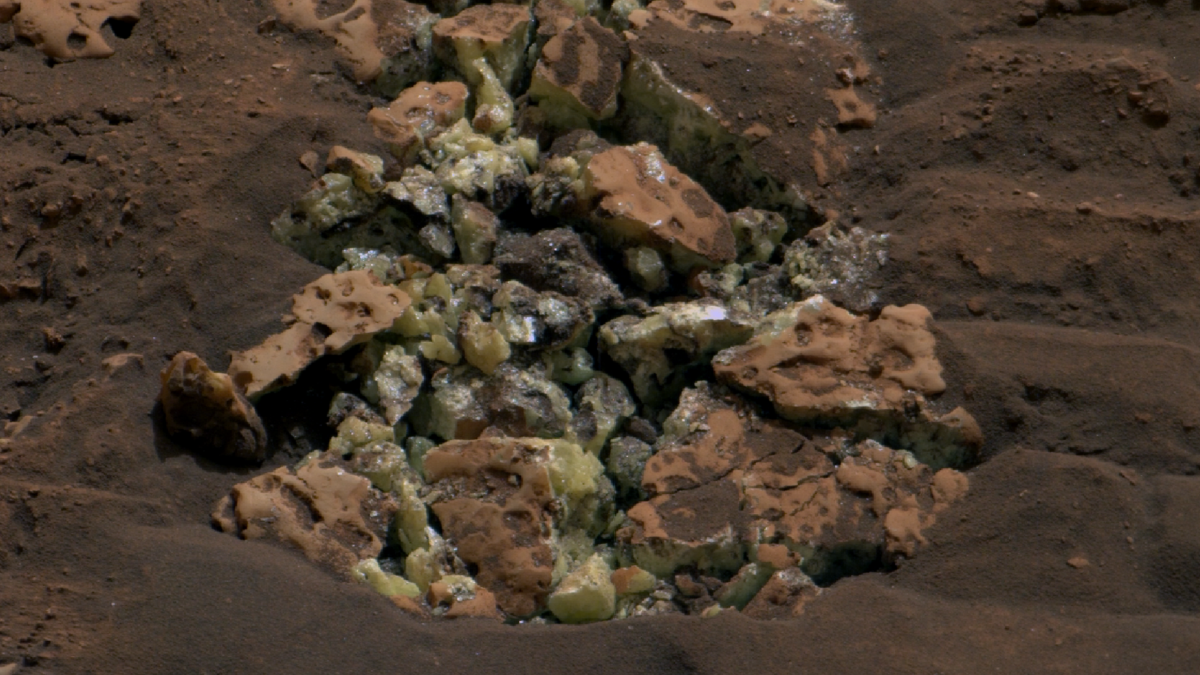
In 2024, NASA's Curiosity rover rolled its 899-kilogram frame across a seemingly ordinary stone in Gale Crater's Gediz Vallis Channel, cracking it open to reveal pale yellow crystals glinting under the Martian Sun. Scientists were immediately stumped: the fractured rock contained pure elemental sulfur, a first on the Red Planet, surrounded by an entire field of identical stones. Now, two newly published studies in Science and Geophysical Research Letters have pieced together how this unexpected deposit formed billions of years ago without the extreme heat typically required on Earth.
What Was Achieved
Planetary scientists have solved a major piece of a geological puzzle that began when Curiosity accidentally crushed a fragile rock in 2024. While sulfur-bearing salts known as sulfates are common across Mars, finding pure elemental sulfur—also called brimstone—had never happened before.
In a June 2026 study published in Science, a team led by planetary scientist Scott VanBommel of Washington University in St. Louis analyzed Curiosity's imagery and chemical readings from the site. Their work confirmed that the pure sulfur stones are scattered across an area measuring roughly 2,100 square meters and possess remarkably high purity.
Finding a field of stones made of pure sulfur is like finding an oasis in the desert,
Because Mars has lower gravity than Earth, Curiosity exerts a force equivalent to an object weighing about 341 kilograms on Earth. The ease with which the rock popped open under that weight revealed that the stones are highly fragile—meaning they likely formed directly inside Gediz Vallis rather than surviving a rough journey from elsewhere.
How It Works
On Earth, large deposits of pure sulfur usually form near volcanoes or hydrothermal vents where intense heat drives chemical reactions. Gediz Vallis, however, shows no evidence of those high-temperature conditions, prompting researchers to investigate low-temperature pathways.
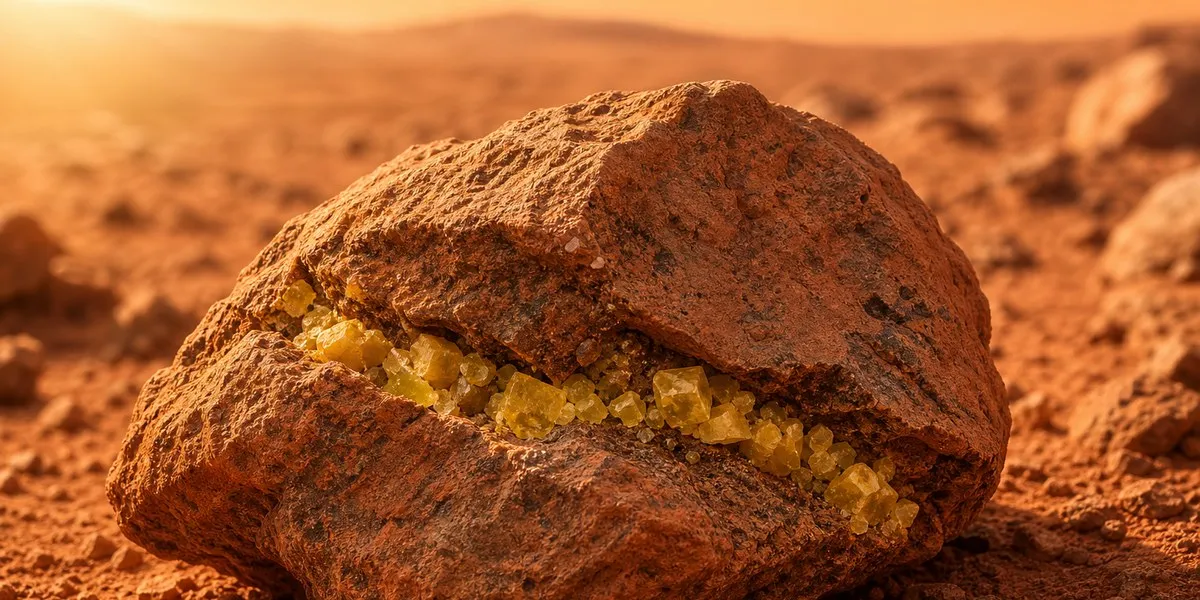
VanBommel's team proposed a subterranean gas-release mechanism in their Science paper:
- Ancient volcanic trapping: Gases released by early Martian volcanic activity cooled and became trapped underground inside icy structures called clathrates.
- Erosion and pressure drop: As erosion later carved out the Gediz Vallis channel, pressure on the buried reservoirs dropped, allowing the trapped gases to escape.
- Cold chemical reactions: Escaping sulfur-bearing gases reacted with one another to form solid deposits of pure sulfur without requiring local volcanic heat.
Based on the surrounding geology, the researchers estimate this sulfur field formed between 3.1 and 2.8 billion years ago.
What Has Been Demonstrated
To test whether water chemistry could also produce pure sulfur in a cold environment, a second research group led by atmospheric scientist Jiawei Wang at Cornell University conducted laboratory simulations, publishing their findings in Geophysical Research Letters in July 2026.
The team mixed dissolved sulfide with chlorate—a chlorine-and-oxygen compound believed to have existed on ancient Mars—in acidic water at room temperature. The chemical reaction successfully precipitated microscopic yellow crystals of pure elemental sulfur.
Crucially, the researchers demonstrated that chemical concentration dictates the final mineral outcome:
- Lower chlorate levels: Favored the creation of pure elemental sulfur crystals.
- Higher chlorate levels: Produced standard sulfate minerals instead.
Wang's team noted that hydrogen sulfide from the underground reservoirs proposed by VanBommel's group could have supplied the necessary ingredients for this room-temperature water reaction. Over extended geological timescales, these microscopic precipitates could accumulate into larger stones like those Curiosity crushed.
What Problems It Could Solve
Understanding how pure sulfur forms without high heat or biological help resolves a critical question for astrobiology and planetary science. Sulfur is an essential element for all known life, used by organisms to build two vital amino acids for proteins.
On Earth, microbes frequently produce elemental sulfur, which initially raised questions about whether Martian brimstone pointed toward ancient biological activity. Wang's experiments demonstrate that non-living chemical reactions in acidic water can generate pure sulfur on their own, preventing scientists from misinterpreting abiotic mineral deposits as signs of life.
Mars provides us with a frozen snapshot from billions of years ago. We can go back and look at deep time in a way that we can't do on Earth.
Because Earth's active geology constantly recycles its crust, preserved 3-billion-year-old surfaces are rare. Studying untouched deposits like the Gediz Vallis sulfur field allows researchers to reconstruct ancient planetary chemistry and better understand how rocky worlds evolve.
What Still Needs to Happen
While the two studies establish plausible chemical pathways, researchers still need to determine whether gas-phase reactions, room-temperature water chemistry, or a combination of both produced the Gediz Vallis field. Further analysis of how microscopic sulfur crystals grow into larger, fragile rocks over millions of years is also needed to bridge the gap between Wang's laboratory results and the full-sized stones observed by Curiosity.
Readers interested in the original findings can review the full coverage via ScienceAlert's report on the Curiosity sulfur studies.
Frequently Asked Questions
What did NASA's Curiosity rover find in Gediz Vallis?
Curiosity accidentally cracked open a rock in Gale Crater's Gediz Vallis Channel in 2024 and discovered crystals of pure elemental sulfur—the first time pure sulfur has been identified on Mars.
How large is the pure sulfur field on Mars?
According to a June 2026 study in Science, fragile rocks containing pure elemental sulfur are scattered across an area of roughly 2,100 square meters.
How old is the Martian sulfur deposit?
Researchers estimate from the surrounding geological context that the pure sulfur deposit in Gediz Vallis formed between 3.1 and 2.8 billion years ago.
Does pure sulfur on Mars prove ancient life existed?
No. A July 2026 study in Geophysical Research Letters demonstrated that mixing dissolved sulfide and chlorate in acidic water at room temperature produces pure sulfur without any living organisms.
Why didn't the sulfur rocks break before Curiosity drove over them?
Scientists concluded the fragile rocks formed directly inside Gediz Vallis rather than being transported from another location, allowing them to remain intact until Curiosity's weight crushed them.