
The camera lights flickered against the pitch-black seafloor, revealing something no one expected — a smooth, glowing golden sphere sitting quietly in the deep. It looked almost artificial. Then the questions started.
After months of analysis, scientists have finally identified the mysterious “golden orb” discovered miles beneath the ocean off Alaska. The answer? Not alien tech, not treasure — but something far stranger and far more natural.

How Events Unfolded
It started during a 2023 deep-sea expedition led by the National Oceanic and Atmospheric Administration. Researchers were exploring roughly two miles below the ocean surface near Alaska when the orb appeared on camera — smooth, metallic-looking, and oddly pristine.
At first glance, it didn’t behave like anything familiar. No obvious markings. No movement. Just a tiny hole on one side, almost like something had emerged or entered.
Scientists collected the object carefully, bringing it back to the surface for further testing. And here’s the thing — even after initial analysis, the team couldn’t immediately classify it.
Speculation spread quickly. Was it biological? Mineral? Something entirely new? It had that “what on earth is that?” vibe that keeps oceanographers up at night.
Under the Surface
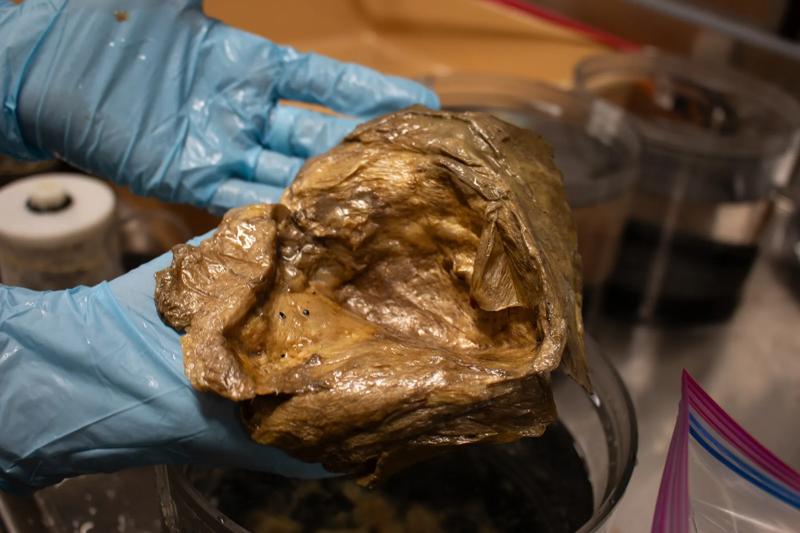
Months of lab work finally delivered an answer: the orb is believed to be a biological egg casing — likely from a marine organism, possibly a sponge or a yet-unidentified species.

What’s interesting is how unusual it is. Most known deep-sea eggs don’t have this glossy, gold-toned exterior. Researchers say the texture and composition point to a soft-bodied organism that may have adapted to extreme pressure and darkness.
Even now, scientists aren’t 100% certain which species produced it. But the presence of organic tissue inside confirmed it wasn’t mineral or man-made.
This isn’t the first time the deep ocean has surprised researchers — but it’s a reminder of how much remains unexplored. Roughly 80% of Earth’s oceans are still unmapped, meaning discoveries like this are far from rare.
Voices & Opinions
“We still don’t know exactly what organism created it, but we’re confident it’s biological in origin.”
Researchers emphasized that the discovery highlights the limits of current marine biology knowledge. Even seasoned scientists admitted they were puzzled at first — and that’s saying something.
Marine experts say these findings could help expand understanding of reproduction in extreme environments. And in some cases, new discoveries like this can even reshape how scientists classify entire groups of organisms.
Putting It in Perspective
So why does this matter beyond the lab?
For Canadians — especially those along the Pacific coast — this kind of research connects directly to ocean conservation and fisheries. Understanding how deep-sea species reproduce can influence policies around deep-water mining and fishing practices.
It also feeds into a bigger picture. Discoveries like this push governments and institutions to invest more in ocean exploration. Out of sight shouldn’t mean out of mind, especially when these ecosystems play a role in climate balance and biodiversity.
And let’s be real — if something this unusual can sit unnoticed for who knows how long, what else is down there?
Looking Ahead
Scientists plan to continue analyzing the orb’s genetic material to pinpoint its exact origin. Future expeditions may return to the same region to search for similar specimens.
Meanwhile, this discovery adds another layer to a growing truth: the ocean still holds more questions than answers. And every dive seems to uncover something new.
FAQ
What is the golden orb found in the ocean?
It’s believed to be a biological egg casing from a deep-sea organism.
Where was the orb discovered?
Off the coast of Alaska, about two miles underwater.
Why did scientists find it unusual?
Its smooth, gold-like appearance and unknown origin made it unlike known marine eggs.
Is it dangerous?
No evidence suggests any danger — it’s a natural biological object.
Do scientists know which species created it?
Not yet. Further genetic analysis is ongoing.
Why is this discovery important?
It highlights how little we know about deep-sea life and could impact marine research and conservation.