
Albertans are used to many things, but waking up to the ground moving isn't usually one of them. A 4.5-magnitude earthquake rattled regions north of Edmonton on Wednesday afternoon, serving as a jarring reminder that the Prairies aren't always as stable as they seem. For those in St. Albert, Morinville, and the capital itself, the sudden tremor turned a quiet day into a flurry of social media check-ins and rattled nerves.

Setting the Scene
While Alberta isn't a global hotspot for seismic activity like British Columbia or California, it is no stranger to the occasional rumble. Historically, most seismic events in our province are linked to either deep-seated natural faults or, increasingly, industrial activity like fracking and wastewater injection. However, a 4.5-magnitude quake is significant for this region—it is strong enough to be felt clearly across multiple municipalities without being behind the 8-ball when it comes to major structural damage.
What makes this specific event curious is its proximity to the capital region. Most Alberta quakes tend to cluster near the foothills or the Peace River area. When the ground starts acting up so close to major population centers, it naturally raises questions about local infrastructure and whether our building codes are truly ready for more frequent tremors.
Here's What Happened
The tremor struck at approximately 12:56 PM local time, with its epicenter located roughly 42 kilometers north of Edmonton. Initial reports from Earthquakes Canada pinned the magnitude at 4.5, a level that classifies as 'moderate.' Residents reported seeing light fixtures sway and hearing a low rumble that sounded like a heavy truck passing by. Within minutes, hundreds of 'felt it' reports flooded into the seismology tracking centers.
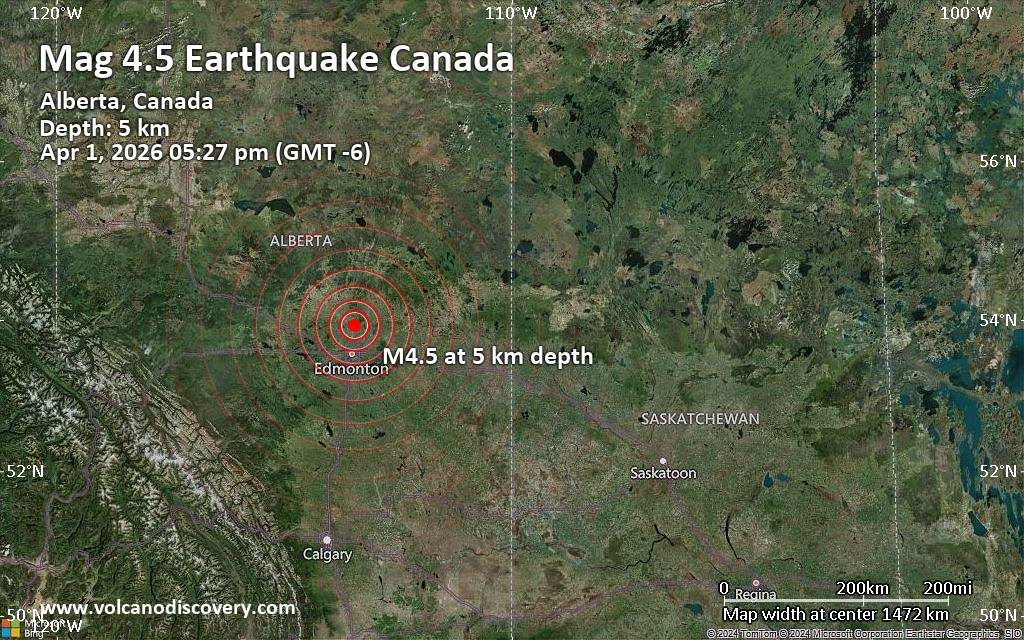
The depth of the quake was relatively shallow, which often explains why the shaking feels so sharp and immediate to those nearby. Following the main event, there were no immediate reports of major injuries or significant damage to highways or public buildings. Emergency services in Morinville and St. Albert remained on standby, though the consensus was that this was more of a wake-up call than a catastrophe. It's the kind of event that makes you realize you're skating on thin ice if you don't have a basic emergency kit ready.
Reactions & Responses
Local authorities were quick to monitor critical infrastructure, particularly natural gas lines and water mains which can be sensitive to ground shifts. In Edmonton, workers in downtown high-rises noted the distinct swaying of the upper floors, leading to a few voluntary evacuations as a precaution. Many locals took to the web to share their experiences, noting that while the shake was brief, it was unmistakable.
The reaction from the scientific community is one of focused observation. Seismologists are currently analyzing whether this was a strictly natural tectonic event or if it bears the hallmarks of induced seismicity. For people living in the affected area, the primary concern is the potential for aftershocks, which can sometimes follow events of this magnitude, though they are usually smaller and less noticeable.
The Bigger Picture
This earthquake highlights a growing conversation in Alberta about seismic resilience. While we are a province built on oil and gas, we are also a province of growing cities. A 4.5-magnitude event might not knock down a house, but it can cause subtle damage to older masonry and underground utilities that might not show up until months later. It serves as a reminder for homeowners to check their foundations and for the province to keep a close eye on regional industrial pressure.

The Road Ahead
Natural Resources Canada will continue to refine the data from this event over the next 48 hours. No major aftershocks have been confirmed yet, but residents are advised to secure heavy furniture and be aware of their surroundings. For now, it seems Alberta has survived its latest rumble with little more than some rattled dishes and a lot of chin-wagging at the local coffee shop.
FAQ
- How strong was the Alberta earthquake today?
- The earthquake was recorded as a 4.5-magnitude event, which is considered moderate.
- Where was the epicenter of the quake?
- It was located approximately 42 kilometers (26 miles) north of Edmonton, near the town of Morinville.
- Was there any damage reported in Edmonton or St. Albert?
- There have been no reports of major structural damage or injuries, though many residents reported feeling significant shaking.