
August 12, 2026 will mark the beginning of a rare astronomical double-header that stargazers across Canada have been anticipating for years.
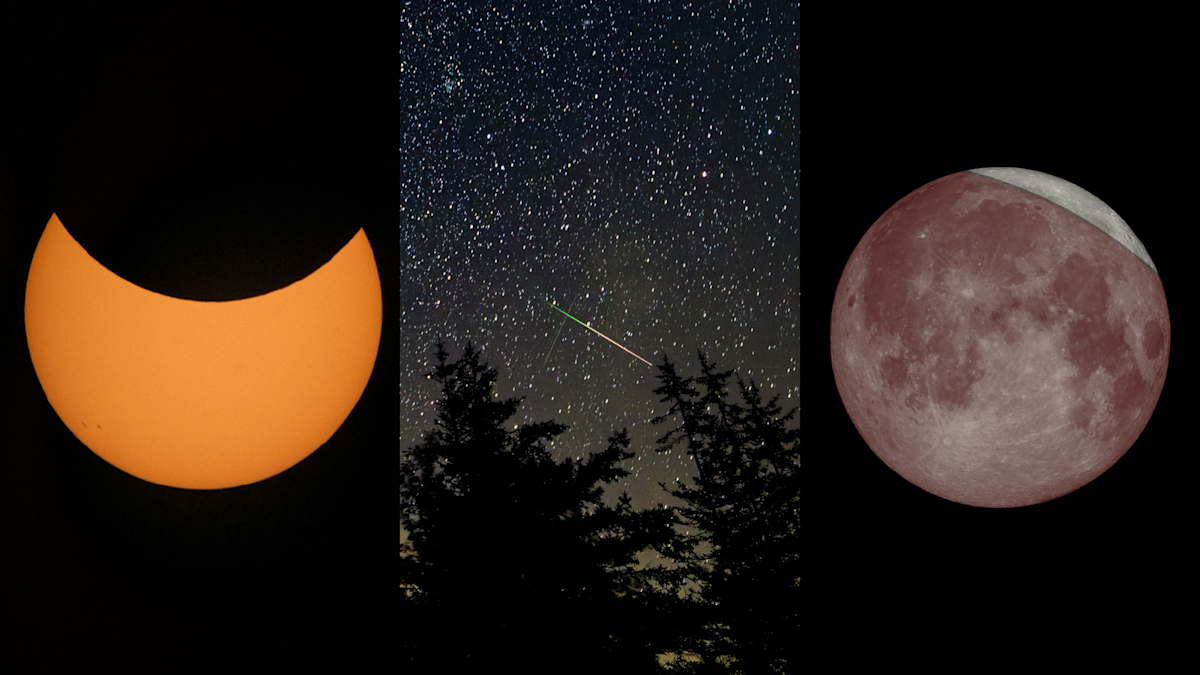
A partial solar eclipse will sweep across the country during the day, perfectly priming the night sky for the peak of the Perseid meteor shower. Because the New Moon will completely block the Sun's light along its path of totality, it ensures an entirely dark sky that evening. This rare alignment eliminates all moonlight interference, creating what astronomers predict will be the best conditions for the Perseids in recent memory.
The Bottom Line
- August 12 features a partial solar eclipse visible across most of Canada, with northern and eastern regions seeing the highest magnitude of coverage.
- The eclipse path of totality tracks through the Arctic, Greenland, Iceland, Portugal, and Spain, lasting up to 2 minutes and 18 seconds.
- The New Moon causing the eclipse guarantees zero moonlight pollution for the Perseid meteor shower peak on the night of August 12–13.
- Skywatchers can expect 75 to 100 meteors per hour during the Perseids' peak, including exceptionally bright fireballs visible from cities.
- August's cosmic lineup concludes with a spectacular partial lunar eclipse on August 27–28, visible across all of Canada.
Breaking It Down
The cosmic marathon begins mid-day on August 12. While the path of totality skips Canadian soil, flying instead from northern Siberia through Greenland and Europe, a significant partial eclipse will be visible from coast to coast. For observers in Atlantic Canada, the celestial alignment starts in the early afternoon, peaks mid-afternoon, and wraps up by late afternoon. The magnitude of the eclipse changes depending on geography, offering the most dramatic views to those positioned farther north and east, such as on Baffin Island or the coastal tips of Newfoundland and Labrador.
Because looking directly at the Sun is hazardous, Canadians must use certified eclipse viewing glasses to protect their eyes during the day. What makes this particular day extraordinary, however, is what happens after the Sun sets. The exact same New Moon that blocks the daytime sun leaves the nighttime sky completely dark, establishing a pristine canvas for the annual Perseid meteor shower.
Every year from mid-July through late August, Earth plows through the ancient debris stream left behind by Comet 109P/Swift-Tuttle. As these small particles of ice and dust compress the atmosphere at high speeds, they create glowing streaks of light. The numbers will ramp up dramatically around August 9, culminating in a peak display on the night of August 12 and the early morning of August 13. Because the radiant point near the constellation Perseus climbs higher as the night progresses, the absolute best window for viewing will be the hours right before morning twilight.
Why This Matters
For skywatchers in Canada, the convergence of a solar eclipse and a peak meteor shower on the exact same date is a rare structural alignment. Typically, a bright moon can wash out all but the brightest meteors, reducing visible counts significantly. This August, the natural synchronization of the lunar cycle maximizes reader-value by delivering a flawless dark sky, provided local weather cooperates. Urban light pollution will still obscure fainter meteors, but the Perseids are famous for producing fireballs—intense bursts of light that can briefly illuminate the ground and remain visible even from bright city centers.
This event fits into a broader summer season exceptionally rich in space phenomena. Earlier in the summer, on July 6 at 1:31 p.m. EDT, Earth reaches aphelion, its farthest point from the Sun for the year at roughly 152,087,777 km. Later in July, the Southern Delta Aquariids peak on July 30–31, offering graceful, long-lasting trails. However, the August double-header stands out because the daytime eclipse directly enables the nighttime meteor spectacle.
What Comes Next
Following the August 12 excitement, the planets and Moon will stage two more confirmed events before autumn arrives. On the morning of August 15, early risers can spot a close Mercury-Jupiter conjunction low on the eastern horizon around 5:15 a.m. local time, though the morning twilight will offer a narrow viewing window.
The grand finale arrives on the night of August 27–28 with a partial lunar eclipse. This event will be visible from coast to coast as the Sun, Earth, and Full Sturgeon Moon align. At its peak, the Moon will be roughly 93 percent immersed in Earth's dark umbral shadow, creating a deep crimson glow visible to all of Canada.
FAQ
When is the best time to see the Perseid meteor shower in Canada?
The peak occurs on the night of August 12 through the early morning hours of August 13, 2026. The ideal viewing window is after midnight and before morning twilight, when the radiant point is highest in the northeast sky.
Can I see the total solar eclipse from Canada on August 12?
No, the path of totality passes over Greenland, Iceland, and Spain. Canada will experience a partial solar eclipse, where the Moon covers a portion of the Sun. Protective eclipse glasses are required at all times.
How many meteors will be visible during the peak night?
Under clear, dark skies away from city lights, observers can expect to see between 75 and 100 meteors per hour. Brilliant fireballs will also be visible from urban areas.
What is causing the lunar eclipse later in August?
On August 27–28, 2026, the Full Moon will pass directly through Earth's shadow, resulting in a partial lunar eclipse where 93 percent of the lunar disk will enter the dark umbra.