
Suns Acquire Arizona Star Koa Peat in Blockbuster NBA Draft Trade
Inside the draft room, the clock was ticking down to the final seconds of opening night. Phoenix Suns general manager Brian Gregory and owner Mat Ishbia engineered a dramatic local homecoming by trading into the absolute tail end of the first round. The front office targeted University of Arizona freshman forward Koa Peat, sending a package of draft capital to secure the 30th overall pick from the Dallas Mavericks after a complex series of draft-night asset swaps.

How Events Unfolded
The path to acquiring Peat required navigate-free execution by the Suns management team. Dallas originally held the 30th pick, which was briefly shuttled through the New York Knicks as they moved down multiple times to avoid punitive luxury tax thresholds before Phoenix finalized the deal. Suns insider John Gambadoro of Arizona Sports 98.7 broke the news that Phoenix had packaged its own No. 47 selection alongside future second-round picks in 2029 and 2033 to jump back into the first round.
Peat had been strongly linked to the Suns leading up to draft night if they could find a workable trade partner. League sources confirmed the team aggressively explored avenues to bolster a thin frontcourt. Choosing to keep his name in the 2026 draft pool after bypassing his remaining NCAA eligibility, the 19-year-old forward waited until the final selection of the opening round to hear his name called.
By sliding to the 30th spot, Peat avoids the risk of going undrafted while securing a standard first-round rookie scaling contract. This deal guarantees his first NBA contract for at least two seasons, with team options remaining for years three and four. This financial reality brings immediate stability to a player who turned down substantial financial opportunities in the collegiate ranks.
The Fine Print
Hailing from Perry High School in Gilbert, where he achieved high school legendary status by capturing four consecutive state titles, Peat is a deeply established figure in local Arizona basketball circles. The 6-foot-8, 245-pound forward chose to play his collegiate ball in Tucson under the Wildcats banner. He immediately established himself as a physical force, averaging 14.1 points, 5.6 rebounds, and 2.6 assists across 36 starts during his freshman campaign.

What drove his draft stock downward during the pre-draft cycle was a stark lack of perimeter efficiency. Peat attempted just 20 total three-pointers during his lone season at Arizona and struggled noticeably during shooting drills at the NBA Draft Combine in May. Scouts and draft evaluators grew split over his modern positional fit, considering he operated primarily inside ten feet of the basket using short jumpers and low-post strength.
The Response
The decision to stay in the draft pool was considered highly volatile by collegiate analysts. Peat could have commanded an estimated $6-7MM+ in name, image, and likeness money had he opted to return to Tucson for his sophomore season to spearhead a potential national title run. Instead, he chose to test the professional waters, trusting that his high-IQ passing and downhill attacking capabilities would convince a front office to lock him in early.
National talent evaluators view the selection as a calculated gamble for a championship-contending Phoenix roster. Draft analysts noted that while Peat lacks elite efficiency as an outside shooter, his spatial awareness and interior playmaking closely mimic established veterans. The Boston Celtics had also heavily scouted the Big 12 standout at pick 27 before ultimate draft-board fluctuations left him available for the Suns to snatch at the buzzer.
Putting It in Perspective
For basketball fans in CA following the draft layout, this trade underscores a growing trend of elite modern prospects prioritizing guaranteed professional developmental minutes over collegiate financial packages. Peat enters a Phoenix frontcourt that has a glaring hole at power forward, giving him a direct path to compete with rotation players like Rasheer Fleming and Ryan Dunn for bench minutes.
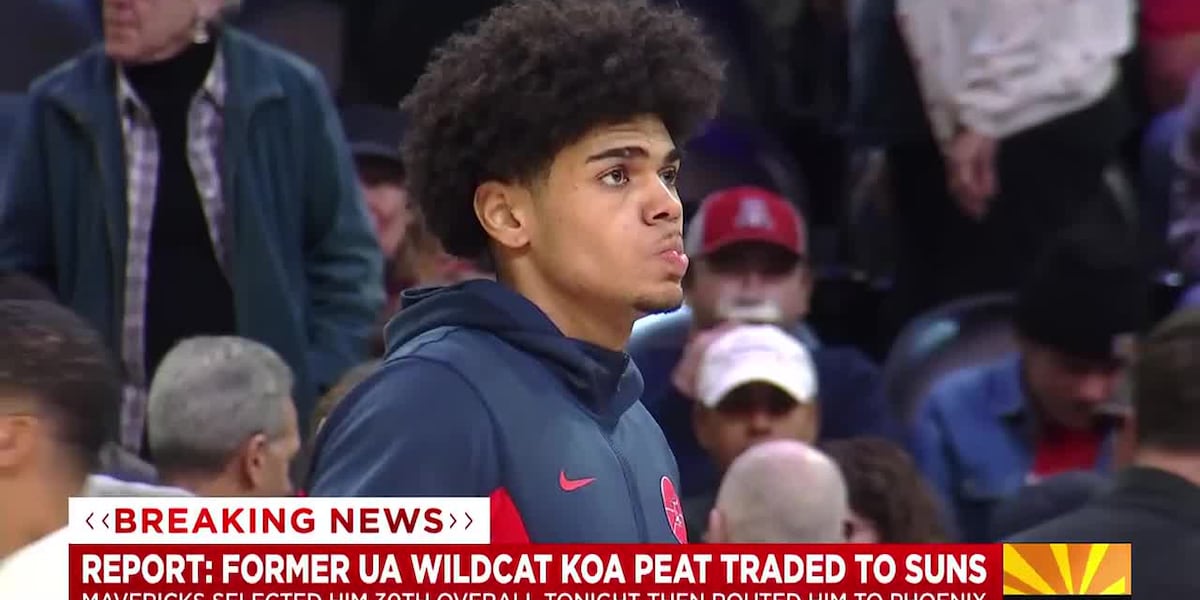
His ability to outplay this draft positioning rests entirely on his physical development and jump shot consistency under head coach Jordan Ott. If the 19-year-old can stretch his offensive game out to the perimeter while anchoring a versatile defense, his bargain rookie contract will provide massive salary cap relief for a heavily taxed Phoenix roster. If his shooting fails to develop, he risks being relegated to a specialized interior reserve role.
Looking Ahead
Peat will officially join the Suns summer league roster in July to begin his transition to professional basketball. The front office will immediately insert him into their player development system to overhaul his shooting mechanics before training camp begins in September. Because Phoenix traded away its remaining draft capital for this cycle, the front office has no selections remaining for the second round of the draft on Wednesday.
Frequently Asked Questions
What did the Suns give up to acquire Koa Peat?
Phoenix traded their No. 47 overall pick in the 2026 draft along with two future second-round draft picks in 2029 and 2033 to secure the 30th pick from the Dallas Mavericks.
Why did Koa Peat fall to the 30th pick in the draft?
Peat was widely projected as a top-10 talent earlier in the season, but his draft stock fell significantly due to questions surrounding his outside shooting mechanics and a poor shooting performance at the NBA Draft Combine.
What were Koa Peat’s stats during his freshman season at Arizona?
He started all 36 games for the Wildcats, averaging 14.1 points, 5.6 rebounds, and 2.6 assists per game while shooting 52.8% from the field.
Is Koa Peat’s contract guaranteed as the 30th pick?
Yes. Because he was selected in the first round, his rookie contract is fully guaranteed for his first two seasons in the NBA, with team options available for the third and fourth years.

Resources
Sources and references cited in this article.