
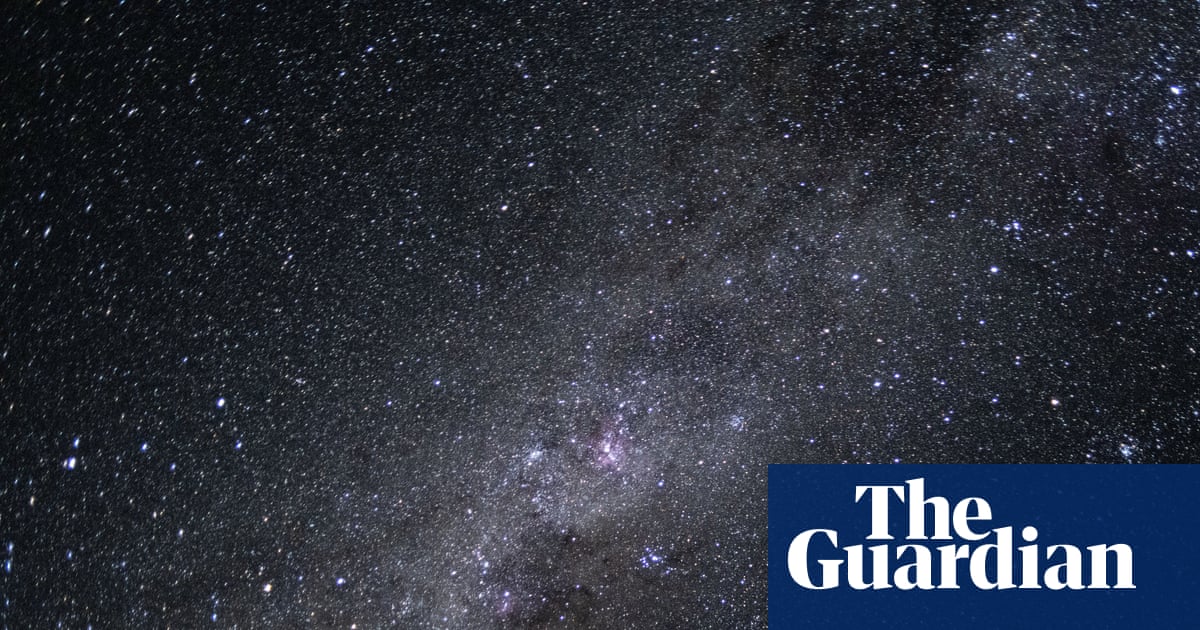
Astronomers have detected the first true sugar ever found in interstellar space: erythrulose, a four-carbon molecule also present in raspberries and self-tanning lotions. The molecule was identified in a vast cloud of gas and dust near the centre of the Milky Way, about 26,700 light-years from Earth. The discovery strengthens the case that some of the chemical ingredients linked to life can form before stars and planets exist.
What We Know So Far
The team studied a chemically rich molecular cloud called G+0.693-0.027 using the Yebes 40-metre telescope and the IRAM 30-metre telescope. By comparing radio emissions from the cloud with laboratory measurements, the researchers identified 12 spectral lines matching erythrulose. The result was published in Nature Astronomy and detailed in the study report.
The result was unexpected. The researchers first searched for simpler sugars containing three carbon atoms but found none. Erythrulose, which has four carbon atoms, was at least eight times more abundant than the undetected three-carbon candidates. That challenges the usual assumption that interstellar molecules grow mainly through the step-by-step addition of single carbon atoms.
The proposed pathway begins on microscopic dust grains chilled to around -250C. Glycolaldehyde and ethylene glycol, two compounds with two carbon atoms each, can meet on icy grain surfaces and combine into erythrulose. Scientific American's account explains how those grains act as surfaces on which more complex chemistry can occur.
The finding matters because sugars are involved in metabolism and in the chemistry behind RNA and DNA. Scientists have previously found sugars in meteorites and in samples from asteroid Bennu, but this is the first direct detection of a true sugar in the interstellar medium beyond the Solar System. Based on the measured abundance, the researchers estimate that between 0.5 million and 50 million metric tonnes of erythrulose may have reached early Earth during the Late Heavy Bombardment, roughly 4.1 to 3.8 billion years ago.
What People Are Saying
This is the very first sugar to be detected in interstellar space and it is important because it tells us that these sugars are more common than we previously thought.
The result shows that a biologically relevant ingredient can arise in cold clouds before planets form; it does not prove that life exists elsewhere.
Rather, its existence in space is an indication that relatively complex molecules [some of which have biological roles on Earth] can be synthesised through abiotic chemical reactions in giant molecular clouds.
Bieske, who was not involved in the study, said the telescope and laboratory signatures matched closely. Spectroscopy cannot show whether the space molecule has the same mirror-image form as the version found on Earth.
How This Affects You
For readers in Britain, the effect is scientific rather than immediate. The finding adds evidence to research on whether early Earth received part of its chemical inventory from comets, asteroids and interstellar dust.

Finding erythrulose in a star-forming cloud means such compounds can be present early in a planetary system's development. Life does not automatically follow, but the result supports searches for other sugars across the galaxy.
Coming Up
The researchers are now working on follow-up experiments to search for more complex sugars and test how fragile molecules respond to ultraviolet light. They also want to look for ribose, a sugar that forms part of RNA, and to understand why four-carbon erythrulose appeared while simpler three-carbon sugars did not.
At a Glance
- Erythrulose is the first true sugar directly detected in interstellar space.
- It was found in the cloud G+0.693-0.027, about 26,700 light-years away.
- Researchers matched 12 radio spectral lines to laboratory measurements.
- The sugar may form on icy dust grains at temperatures near -250C.
- Up to 50 million metric tonnes may have reached early Earth.
Frequently Asked Questions
What sugar was found in space?
Astronomers detected erythrulose, a four-carbon sugar also found in trace amounts in raspberries and used in self-tanning products.
Where was the sugar detected?
It was found in the molecular cloud G+0.693-0.027 near the centre of the Milky Way, around 26,700 light-years from Earth.
How did scientists identify erythrulose?
They compared radio signals from the cloud with laboratory measurements and found 12 spectral lines that matched the molecule's distinctive fingerprint.
Does this prove there is life elsewhere?
No. It shows that a sugar connected to biological chemistry can form in interstellar conditions, but it does not demonstrate that life has developed there.
What happens next?
The team plans to search for more complex sugars, including ribose, and to test how these molecules survive ultraviolet radiation.