

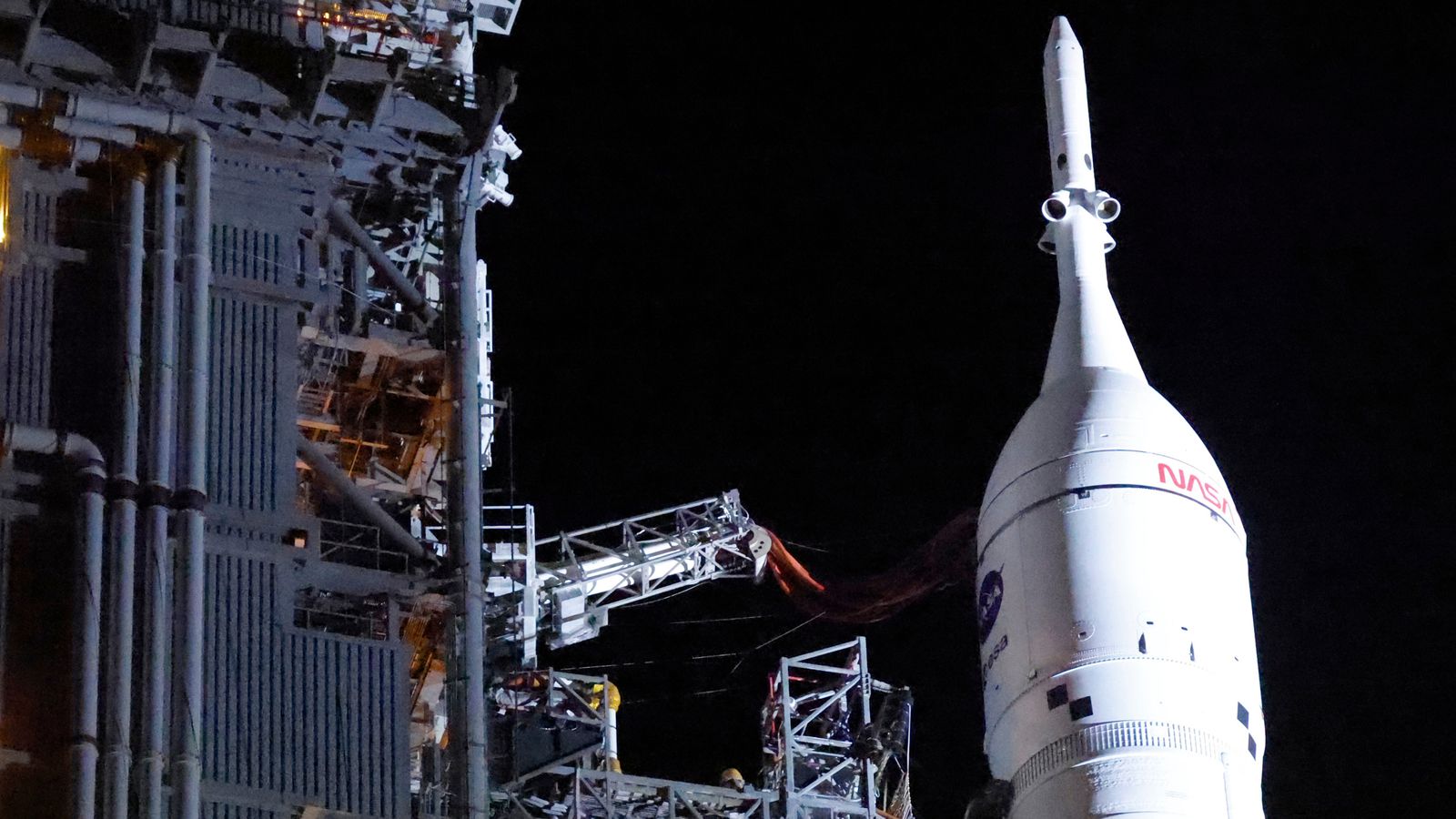
NASA has officially returned the Space Launch System (SLS) rocket and Orion spacecraft to Launch Complex 39B at Kennedy Space Center in Florida as of March 2026. This critical maneuver marks the final countdown for the Artemis II mission, which will carry a crew of four astronauts around the Moon. The mission represents the first time humans will venture to the lunar vicinity in over 50 years.
TL;DR
- NASA has moved the SLS rocket to the launch pad for a targeted April 2026 launch.
- The four-person crew has officially entered pre-flight quarantine to ensure health safety.
- This mission will be the first crewed flight of the Artemis program, orbiting the Moon without landing.
- It establishes the foundation for permanent lunar bases and future Mars exploration.
What Happened
The transition began on March 18, 2026, when NASA finalized the rollout procedures for the Artemis II stack. The massive 322-foot-tall SLS rocket was transported from the Vehicle Assembly Building (VAB) to the launch pad using the crawler-transporter 2. This slow journey covered 4.2 miles and took approximately 10 hours to complete. Upon arrival at the pad, engineers began the process of "hard-down," securing the mobile launcher to the pad's structural supports. Better late than never, as this rollout follows a series of technical refinements aimed at ensuring the safety of the crewed vehicle.

Key Developments
The crew, consisting of Commander Reid Wiseman, Pilot Victor Glover, Mission Specialist Christina Koch, and Mission Specialist Jeremy Hansen (from the Canadian Space Agency), has officially entered the health stabilization period. This quarantine is a standard NASA protocol to prevent the astronauts from contracting illnesses before launch. You can watch the timelapse of the Artemis II rollout to see the sheer scale of the operation. NASA officials confirmed that the Orion spacecraft passed all final communication and life-support system tests while in the VAB.
This is the heartbeat of the mission. We are no longer just testing hardware; we are preparing to fly our friends and colleagues into the deep unknown.
Why This Matters
The Artemis II mission is a 10-day flight test designed to prove that Orion's life-support systems can sustain astronauts in deep space. The sky is the limit for international cooperation, as this mission marks the first time a non-American (Hansen) will travel to the Moon's vicinity. Successfully completing this flight is the mandatory prerequisite for Artemis III, which aims to land the first woman and first person of color on the lunar surface. Strategically, this mission asserts renewed lunar presence amidst a changing global space agenda.
What Happens Next
NASA is currently targeting a launch date in April 2026, with specific windows depending on lunar alignment and weather conditions. Over the next week, teams at Pad 39B will conduct terminal countdown demonstrations and wet dress rehearsals. Once launched, the crew will spend approximately 24 hours in high Earth orbit to test systems before performing the Trans-Lunar Injection burn to head toward the Moon.
Key Terms & Concepts
- SLS (Space Launch System)
- NASA's most powerful rocket to date, designed to launch the Orion spacecraft into deep space.
- Trans-Lunar Injection (TLI)
- A propulsion maneuver used to set a spacecraft on a trajectory that will cause it to arrive at the Moon.
- Crawler-Transporter
- A massive tracked vehicle used to move the rocket and its mobile launcher from the assembly building to the launch pad.
Frequently Asked Questions
When is the Artemis II launch date?
NASA is currently targeting a launch in April 2026, with the rocket having returned to the launch pad on March 20, 2026.
Who are the astronauts on Artemis II?
The crew includes NASA astronauts Reid Wiseman, Victor Glover, and Christina Koch, along with Canadian Space Agency astronaut Jeremy Hansen.
Will Artemis II land on the Moon?
No, Artemis II is a lunar flyby mission. The crew will travel around the far side of the Moon and return to Earth to test the Orion spacecraft's safety systems.
Why is the crew in quarantine?
The crew entered health stabilization on March 18, 2026, to ensure they do not carry any viruses or infections into space, which could compromise the mission.
How long will the mission last?
The Artemis II mission is expected to take approximately 10 days from launch to splashdown in the Pacific Ocean.