
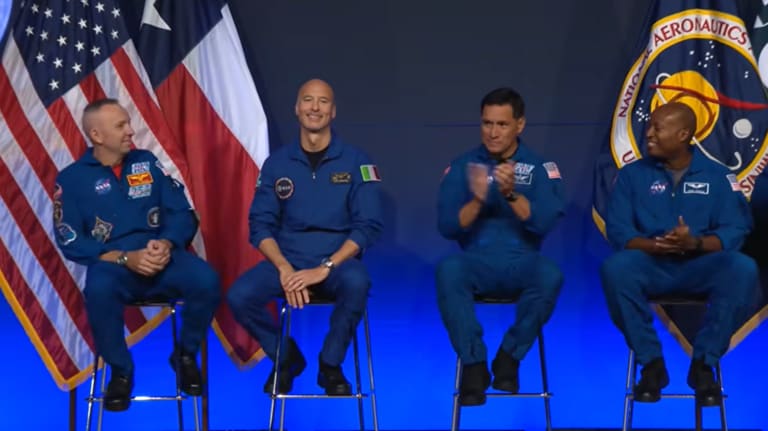
Four astronauts have been named for Artemis III, the mission NASA says will test the docking operations needed before humans return to the lunar surface. The crew will fly in Earth orbit rather than land on the Moon, but the assignment is a major step towards a planned lunar South Pole mission in 2028. For Britain and Europe, the standout detail is historic: ESA astronaut Luca Parmitano will become the first European assigned to an Artemis mission.

The Bottom Line
- NASA named Randy Bresnik, Luca Parmitano, Andre Douglas and Frank Rubio as the Artemis III prime crew.
- Bob Hines will train as the backup crew member and could join the mission if a primary astronaut cannot fly.
- The flight is expected to last about two weeks, with Orion launching from Kennedy Space Center aboard the Space Launch System rocket.
- Artemis III will test rendezvous and docking with lunar lander pathfinders from Blue Origin and SpaceX in low Earth orbit.
- The mission is designed to reduce risk before Artemis IV, which NASA describes as the first planned crewed mission to the lunar South Pole in 2028.
Breaking It Down
The crew announcement changes the public shape of Artemis III. NASA astronaut Randy Bresnik will command the mission, ESA’s Luca Parmitano will serve as pilot, while NASA astronauts Andre Douglas and Frank Rubio will fly as mission specialists. The official mission outline says the astronauts will begin training immediately on Orion systems while also helping develop test versions of the Blue Origin and SpaceX landers.
The mission plan is deliberately intricate. NASA says the agency’s SLS rocket will launch Orion and its crew from Kennedy Space Center into low Earth orbit. After Orion checkouts, the spacecraft will demonstrate rendezvous and docking with test versions from one or both commercial human landing systems being developed by Blue Origin and SpaceX, a sequence NASA describes as a highly choreographed multi-launch campaign.
Blue Origin’s lander pathfinder is expected to launch first and wait in orbit. Orion would then dock with it for about two days of tests and demonstrations, including crew entry into the lander. After that, Orion would separate and await SpaceX’s Starship pathfinder, which would connect for about a day of checkouts before the crew returns to splash down in the Pacific Ocean.
Parmitano’s role gives the mission a clear European dimension. ESA says it is also providing the third European Service Module, the part of Orion that supplies power, propulsion, thermal control, air and water. That module has completed acoustic testing and is due to be connected with the Orion crew module before the spacecraft continues its launch preparation.
Why This Matters
Artemis III is not the Moon landing many casual observers once expected, but that is exactly why it matters. NASA’s revised plan puts the most dangerous choreography — spacecraft rendezvous, docking, crew transfer procedures, interfaces, software, propulsion and communications — through a crewed test closer to Earth before sending astronauts towards the lunar surface.
The European seat is more than symbolism. Parmitano has spent 366 days in space across two long-duration ISS missions, performed six spacewalks totalling more than 30 hours and previously commanded the station. His selection recognises ESA’s practical contribution to Orion and gives European spaceflight a visible place in the programme that is meant to lead from lunar testing to a sustained human presence on the Moon.
There is also a strategic edge. NASA and its partners are trying to move quickly while commercial landers remain under development. The agency says Artemis III will feed lessons into Artemis IV, the planned 2028 lunar South Pole mission, while commercial partners continue building test articles and launch systems.
What Comes Next
The crew will now train on Orion spacecraft systems and lander operations. NASA says engineers will connect the Orion crew module and service module this summer, integrate the spacecraft’s docking system, continue heat shield work, and begin rocket stacking preparations as the mission heads towards a 2027 test flight.
A later Moon landing is planned from Artemis IV onwards. If Artemis III proves the docking and crewed operations work as intended, NASA’s next target is a crewed mission to the lunar South Pole in 2028, the first such attempt in more than 50 years.
FAQ
Who are the Artemis III astronauts?
The prime crew is Randy Bresnik as commander, Luca Parmitano as pilot, and Andre Douglas and Frank Rubio as mission specialists. Bob Hines will train as backup crew member.
Will Artemis III land on the Moon?
No. The mission is planned as a crewed Earth-orbit test flight. It will practise rendezvous and docking with lunar lander pathfinders before a later Moon landing mission.
Why is Luca Parmitano’s selection historic?
Parmitano is the first European Space Agency astronaut assigned to an Artemis mission. ESA is also providing Orion’s European Service Module for the flight.
How long will Artemis III last?
NASA expects the crew to remain in space for about two weeks, though the exact length will depend on launch, rendezvous and docked operations.
When is the next Moon landing planned?
NASA says Artemis IV is the first planned crewed mission to the lunar South Pole, currently aimed for 2028 after Artemis III testing.