
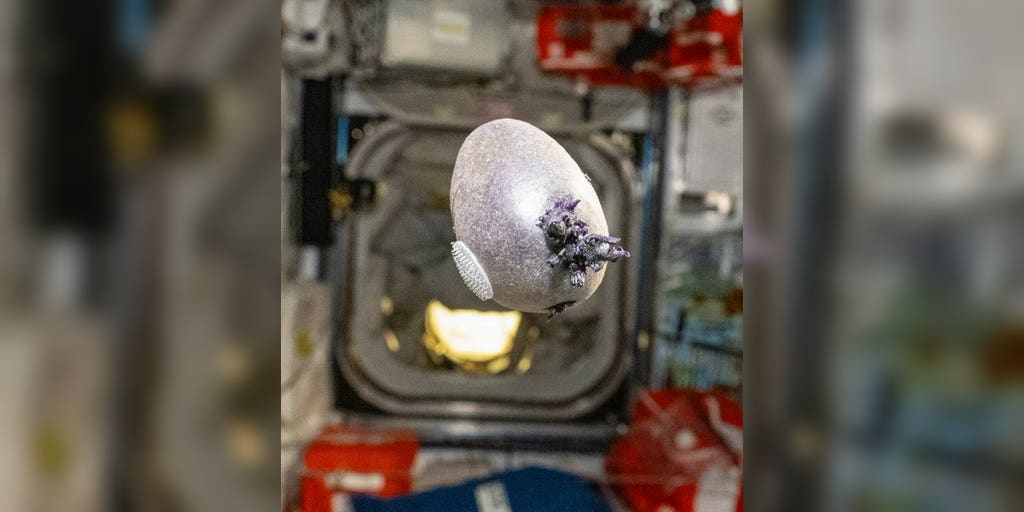
NASA astronaut Don Pettit shared images of a purple, tentacled object growing inside a laboratory on the International Space Station (ISS) in March 2026. The abnormal growth, which initially sparked online speculation regarding extraterrestrial life, was confirmed to be a sprouting potato specimen undergoing microgravity research. The revelation has highlighted the unique biological transformations that occur in orbital environments during long-duration space missions.
Key Points
- NASA astronaut Don Pettit documented a potato sprouting long, dark tentacles while stored in the ISS laboratory.
- The growth demonstrates how plants react to microgravity, producing elongated sprouts rather than typical terrestrial patterns.
- Social media reactions to the image were intense, with many users jokingly calling for the object to be destroyed.
- The experiment is part of ongoing research to understand how to grow sustainable food sources for deep-space travel.
What Happened
During his current tenure on the ISS, veteran astronaut Don Pettit encountered a potato that had begun to sprout in an unusual manner. Unlike Earth-grown potatoes, which typically sprout short 'eyes,' this specimen developed 10 to 15 centimetre long, purple-black tentacles that appeared to reach out into the station's cabin. Pettit photographed the object and shared it on social media, cheekily referring to it as 'Spudnik' and noting its alien-like appearance.

Key Developments
NASA officials clarified that the object was part of a botanical study rather than a biological hazard. Biological specimens on the ISS are often kept in controlled environments, but the lack of gravitational orientation causes sprouts to grow in any available direction. The purple hue is attributed to specific anthocyanin levels stimulated by the ISS's artificial lighting systems. Despite the eerie appearance, the potato remains a standard Earth-based vegetable adapted to the final frontier.
It’s a potato. Just a potato that doesn't know which way is up.
Why This Matters
Understanding how tubers behave in space is critical for future missions to Mars and the Moon. If astronauts are to survive multi-year journeys, they must be able to cultivate crops in 0 gravity environments. The exaggerated growth of the sprouts provides data on nutrient distribution and cellular expansion in plants outside of Earth's atmosphere. This incident served as a reminder of the public's fascination with space biology and the potential for a storm in a teacup regarding misinterpreted scientific data.

What Happens Next
The 'Spudnik' specimen will be monitored until the end of its current growth cycle. NASA is expected to release a formal report on the microgravity impact on tuber cellular structures later this year. Future shipments of fresh produce to the ISS will continue to include similar specimens for expanded botanical trials.
Key Terms
- Microgravity
- The condition in which people or objects appear to be weightless, affecting how plants grow and fluid behaves.
- Anthocyanin
- A type of flavonoid, a family of powerful antioxidants that can give plants a red, purple, or blue pigment.
FAQ
Is the space potato dangerous?
No, the potato is not dangerous or an alien lifeform. It is a common Earth potato that has sprouted unusually long shoots due to the lack of gravity on the ISS.
Why does the potato have tentacles?
In microgravity, sprouts do not have a gravitational 'down' to guide them. They grow outward in search of light and nutrients, resulting in long, vine-like appendages.
Can astronauts eat the space potato?
While potatoes are edible, these specific specimens are usually for research. Additionally, sprouted potatoes contain higher levels of solanine, which can be toxic if consumed in large quantities.
Who is Don Pettit?
Don Pettit is a veteran NASA astronaut known for his scientific photography and creative experiments on the International Space Station. He is currently serving as a flight engineer on his fourth mission.