
Some US data centres now face waits of up to seven years for grid connections, even as AI companies race to secure more computing power. The pressure is pushing operators towards on-site and behind-the-meter electricity, a shift that could reshape power markets well beyond Silicon Valley. Reports from OilPrice.com, Capgemini, SemiAnalysis and others point to the same problem: the AI boom is no longer just a chips story — it is becoming an electricity story.
What We Know So Far
OilPrice.com reported that rising demand from AI data centres and Bitcoin mining is straining grids, citing a White House warning from July 2025 that electricity prices could rise by as much as 58% by 2030 without $1.4 trillion in new infrastructure investment. The same report said power demand could grow up to 10 times by 2030.
The constraint is not only how much electricity exists. It is also whether data centres can connect to the grid quickly enough. SemiAnalysis said US data centre gross power demand could rise from 21GW in 2026 to 84GW by 2030, while available grid headroom is approaching zero and turns negative by 2027 in its modelling.
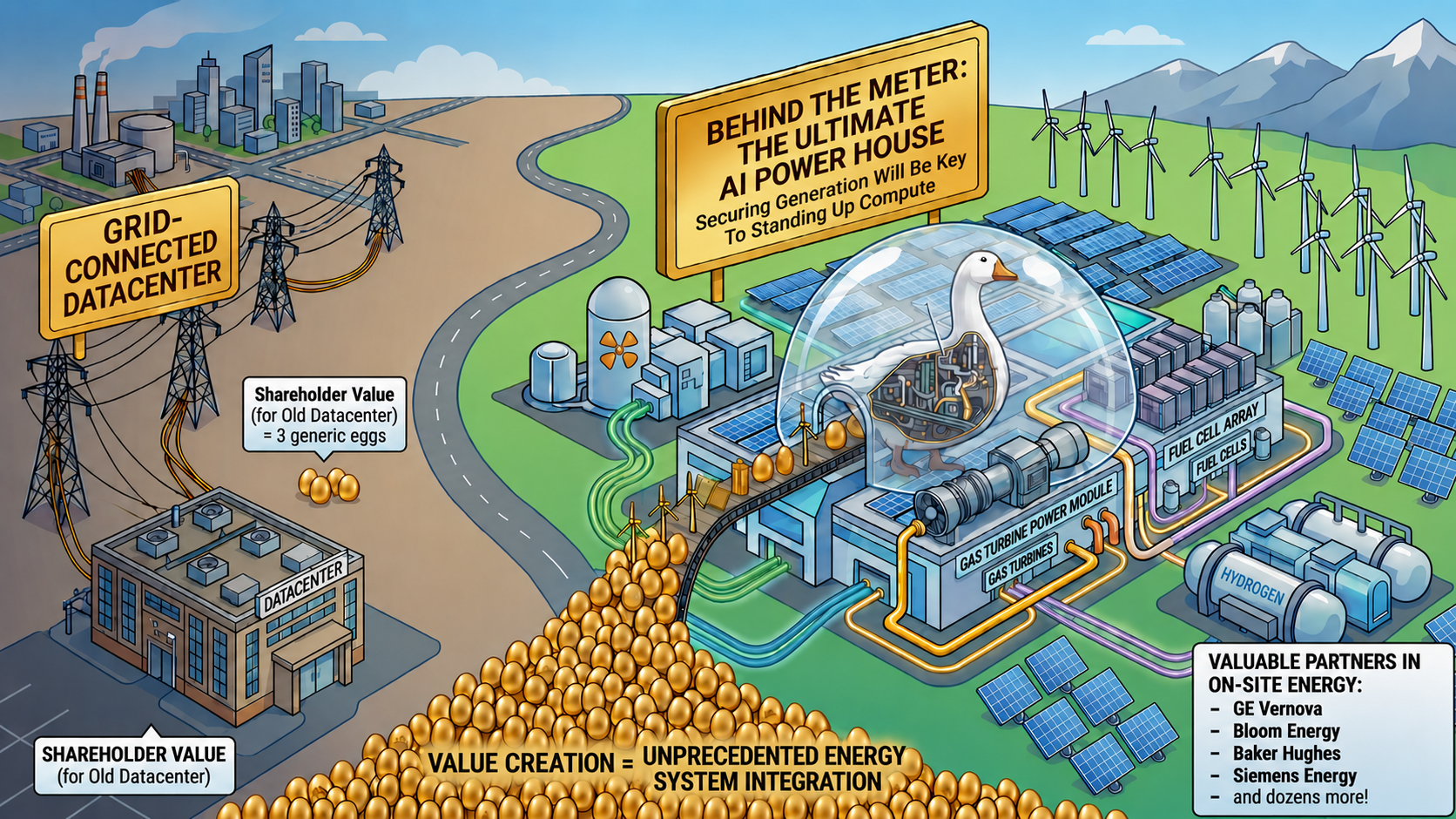
That has made behind-the-meter power a practical answer for operators that cannot wait for conventional connections. Capgemini said nearly three in ten data centres already deploy on-site power solutions, while 39% plan to add on-site or BTM systems within one to two years.
Forecasting is becoming a risk in itself. Capgemini found that 77% of utilities struggle to predict future demand accurately, while 67% refer to “phantom” data-centre load requests, with around 19% of them never materialising. That matters because overbuilding can burden ratepayers, while underbuilding can leave grids short.
What People Are Saying
OilPrice.com cited Shark Tank investor Kevin O'Leary, a strategic investor and partner in Bitzero, describing the grid bottleneck in blunt terms.
There is no power on the grid anymore.
Capgemini framed the issue as a planning and reliability challenge, not simply a growth story.
AI is transforming electricity systems far beyond demand growth.
NTT Global Data Centers also warned that power, supply chains and land are becoming decisive constraints. Its report said demand is expected to grow between 23% and 30% annually in the most likely scenarios, but processors, transformers, switchgear and backup generators could slow deployment.
How This Affects You
For readers in GB, the immediate issue is not whether a US data centre can plug in tomorrow. The bigger relevance is that AI infrastructure is global, and the same pressures — power availability, local planning, grid investment and energy costs — are already part of policy and business conversations in Europe.

The Bulletin of the Atomic Scientists warned that over-forecasting demand can lead to costly overinvestment, while under-forecasting can raise blackout risk. That trade-off matters for households because grid investment costs can work their way into bills, especially if infrastructure is built for demand that never arrives.
The London School of Economics has also been part of the debate. A workshop involving LSE, KDI School, Oxford and other institutions examined AI’s effects on energy demand, labour and data centre economics, underlining how this has moved from a narrow technology issue into wider economic planning.
Coming Up
Several timelines now matter. OilPrice.com said Microsoft’s planned nuclear restart at Three Mile Island is expected in 2028, while Google targets 2030 for its first Kairos Power reactor. Bitzero’s Norway deployment for AI cloud provider OneQode is expected by early 2027 under a 15-year lease for the full 110MW site.
SemiAnalysis said future work will examine transmission constraints and load flexibility, while Capgemini’s report points to AI-enabled grid optimisation as one possible tool. Only 16% of electricity organisations surveyed had implemented advanced AI-driven approaches for power flows, resilience and real-time performance.
At a Glance
- AI data centres are driving a sharp increase in electricity demand.
- Some US data centres face grid connection waits of up to seven years.
- SemiAnalysis expects US data centre gross power demand to reach 84GW by 2030.
- Capgemini found 77% of utilities struggle to forecast future demand accurately.
- Behind-the-meter and on-site power are becoming more attractive as grid timelines slip.
- For GB readers, the key issue is how AI infrastructure may influence energy planning, investment and bills.
FAQ
Why do AI data centres need so much power?
AI systems need large computing campuses for training and inference. These facilities use vast numbers of processors, cooling systems and supporting infrastructure, all of which require continuous electricity.
What is causing the data centre power shortage?
The main constraint is grid connection and deliverable capacity. New power plants, transmission upgrades and interconnection studies can take years, while AI demand is rising faster than grids can adapt.
What does behind-the-meter power mean for data centres?
It means a data centre uses on-site generation, storage or energy management systems to supply power directly, reducing reliance on the public grid.
Could this affect electricity bills?
It could. Sources warn that overbuilding infrastructure for uncertain demand can burden ratepayers, while underbuilding can raise reliability risks and increase pressure on power systems.
What happens next for AI power demand?
Reports point to more on-site power, hybrid grid arrangements, investment in transmission, and growing use of AI tools by utilities to forecast demand and manage power flows.