
Federal transportation data shows that large trucks are involved in over 500,000 police-reported crashes annually, a number fueled by rising commercial freight volume and e-commerce demand. Navigating the aftermath of an 18-wheeler wreck involves far more than filing a standard insurance claim. Because commercial transportation relies on a deeply interconnected network of carriers, logistics providers, and maintenance vendors, a single collision frequently triggers complex, multi-party legal battles where digital telemetry is erased within days.

The Bottom Line
- Large truck injury crashes jumped 5.4% year-over-year in 2024 to 120,724 incidents, leaving 161,201 people injured.
- Federal regulations only require motor carriers to retain driver electronic logging logs for six months before they are routinely purged.
- Commercial vehicles carry policies ranging from $750,000 to $5 million, creating high financial stakes for insurance defense teams.
- More than half of fatal large-truck crashes occur on rural roads, with Thursdays, September, and October showing higher historical incident shares.
- Liability often spans beyond drivers to include carriers, third-party cargo loaders, independent repair shops, and parts manufacturers.
Breaking It Down
A recent decade-long data analysis released by Bailey & Galyen Attorneys at Law on July 18, 2026, revealed that while fatal commercial truck crashes dipped 3 percent in 2024 to 5,218 trucks, nonfatal injury crashes have surged 18 percent since 2016. In these serious incidents, passenger car occupants bear the brunt of the impact, accounting for roughly 70 percent of the 5,340 lives lost in 2024. Certain geographic areas face an outsized burden; for instance, Texas alone recorded 18,834 large truck crashes in 2024, with major freight corridors like I-35, I-10, I-20, and I-45 accumulating dense concentrations of fatal accidents over five-year periods.
When these accidents happen, establishing liability rarely stops with the truck driver. While speeding is the top driver-related factor and distraction ranks second, external administrative and mechanical choices heavily dictate roadway safety. Carrier companies face direct accountability if internal audits reveal they hired operators with prior safety violations, skipped required instruction, or imposed punitive dispatch schedules that forced fatigued driving. Furthermore, thousands of accidents occur overnight when fatigue impairs reaction times in ways comparable to alcohol impairment, despite the presence of federal hours-of-service mandates.
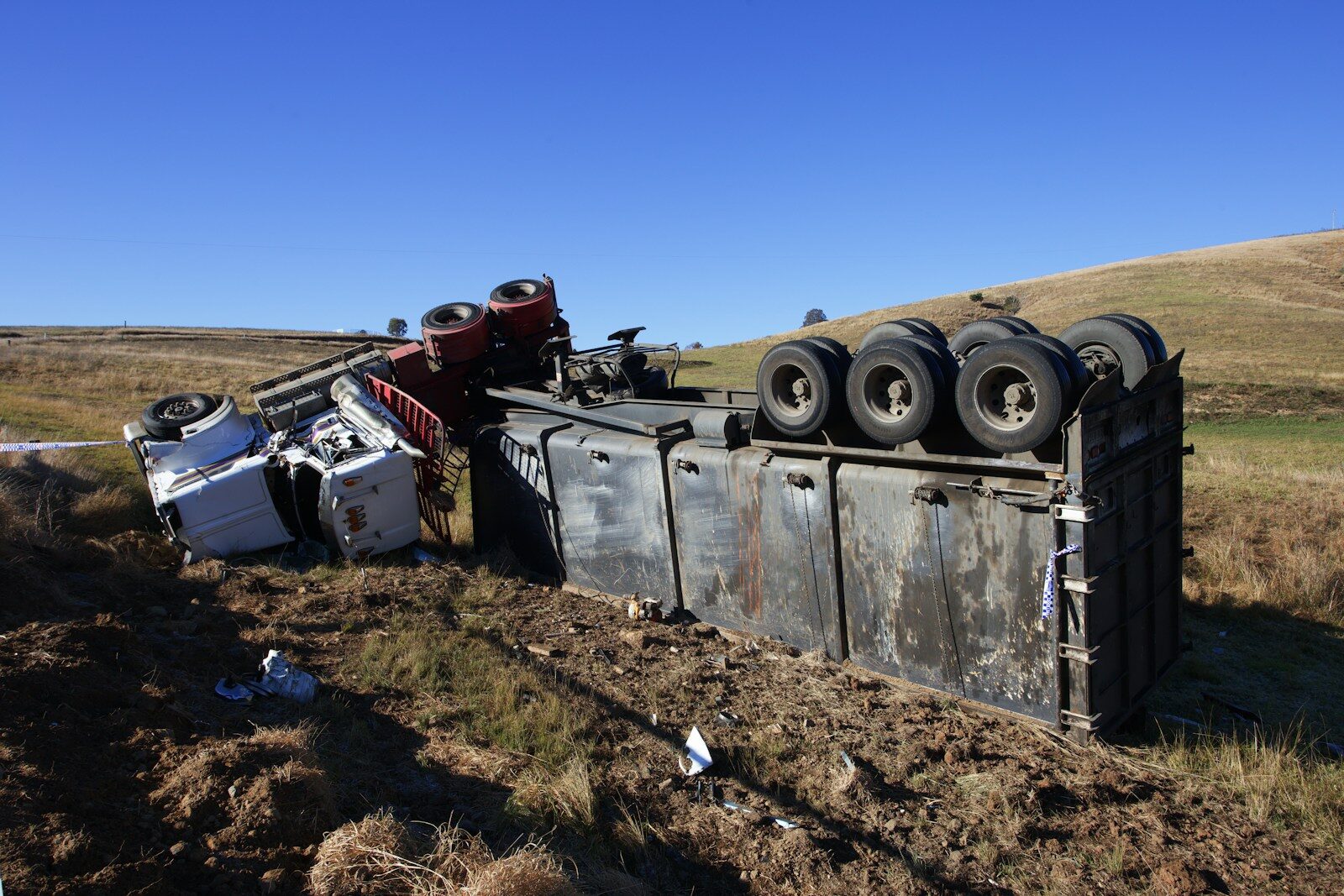
Beyond management, independent actors in the logistics chain frequently share fault. Shippers and warehouse crews are responsible for cargo securement; uneven balancing or excessive weight can trigger rollovers and severe jackknife crashes. Fleet maintenance is another critical vulnerability. Many carriers contract repair services out to third-party shops, and if a mechanic fails to address worn brakes or steering defects, that outside shop is introduced as a defendant. Defective manufacturing components—such as weak coupling assemblies or faulty brake parts—can also pull parts manufacturers into civil litigation, introducing entirely new layers of insurance coverage.
Uncovering these connections requires immediate, aggressive evidence preservation because key digital records vanish incredibly fast. Modern commercial trucks record speed, braking patterns, and hard-braking crash sequences on internal engine control modules, while dash cameras continuously loop video footage, recording over older data every few days. Unscrupulous managers have been known to exploit the standard six-month federal retention threshold to delete incriminating hours-of-service records before litigation begins, forcing plaintiff attorneys to send formal spoliation letters to legally halt administrative purges and protect direct telemetry servers.
Why This Matters
Because commercial vehicles weigh 20 to 30 times more than passenger cars, injury-related expenses for fractures, spinal damage, or traumatic brain injury routinely climb into six figures due to extensive medical care and lost productivity. Navigating these claims places massive pressure on individuals because commercial carriers maintain rapid-response defense teams backed by major insurance providers. These adjusters are trained to secure fast statements from victims, often pushing early settlement offers before the true long-term medical and physical fallout of a whiplash or internal injury is fully documented by a physician.
The high financial exposure—driven by statutory requirements like the Federal Motor Carrier Safety Administration's minimum $750,000 liability coverage mandate for interstate transport—incentivizes corporate defendants to minimize payouts or shift blame between separate entities. When critical logs are missing, investigators are forced to bypass internal files entirely by issuing subpoenas to cell phone providers and third-party fleet communication tech vendors. Attorneys must meticulously cross-reference fuel receipts and weigh-station timestamps to reconstruct accurate routes and uncover hours-of-service violations, illustrating the intense investigative depth required to achieve true accountability.
What Comes Next
While preliminary transportation data from 2025 indicates incremental reductions in fatal commercial crashes in major logistical hubs like Texas, injury-causing incidents show no signs of slowing down. Regulatory compliance and enforcement remain highly fluid, with oversight gaps periodically allowing fatigued driving patterns to persist on high-density corridors. Victims facing immediate recovery hurdles can seek preliminary guidance from firm networks; for instance, Slam Dunk Attorney provides cost-free initial case evaluations for crash victims in Duluth, Georgia, at their 2250 Satellite Blvd suite, while groups like the California Trial Law Group continue tracking regional carrier logbooks to map chains of multi-party liability before critical digital footprints disappear.
Frequently Asked Questions
How quickly do trucking companies delete electronic logs after a crash?
Under federal guidelines, motor carriers are legally permitted to purge electronic hours-of-service logs exactly six months after an incident. This automatic administrative deletion can only be stopped if a formal legal spoliation demand is issued immediately to the carrier.
Can vehicle data be recovered if the engine control module is physically damaged?
Yes. Forensic engineers are regularly able to extract vehicle operational metrics, deceleration patterns, and braking pressure from heavily deformed internal memory banks. The non-volatile memory of a commercial truck's black box is built to survive extreme collision forces.
What happens if a carrier claims their dash camera malfunctioned during a collision?
To counter this defense, investigators immediately demand the historic maintenance and service logs for that specific camera system. A total lack of previously documented technical issues or hardware complaints prior to the wreck strongly indicates intentional formatting rather than an actual device failure.
Why are multiple corporate parties named in a single truck accident lawsuit?
Commercial trucking relies on independent entities. While the driver is responsible for roadway conduct, separate businesses often handle corporate hiring, cargo securement, routine fleet maintenance, and parts manufacturing, meaning several distinct entities can share legal fault for a failure that leads to a crash.
What judicial penalties exist if a defendant intentionally destroys crash evidence?
Trial judges possess the authority to issue severe sanctions for spoliation. These range from adverse inference instructions—which force juries to assume the destroyed data proved the carrier's negligence—to the total exclusion of defense expert testimony, or rare default judgments that automatically award full liability to the plaintiff.