
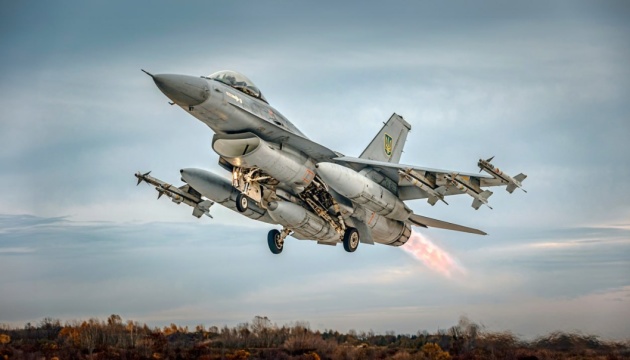
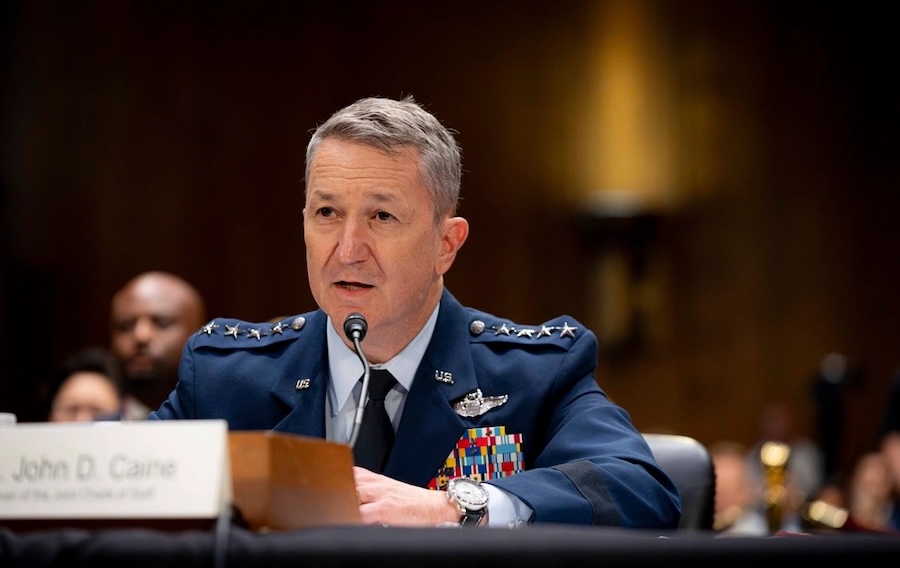
A Ukrainian F-16 fighter jet has achieved its first confirmed air-to-air victory after shooting down a Russian combat aircraft, marking a major milestone for Western-supplied jetliners in the war. General Dan Caine, chairman of the U.S. Joint Chiefs of Staff, confirmed the landmark shootdown to American lawmakers during a Senate hearing on July 21.

The Story at a Glance
Speaking before the Senate Appropriations Committee, Gen. Caine highlighted how Kyiv has scaled its multi-layered air defense capabilities since receiving Western fighters. During the testimony, Caine noted:
Although Caine did not specify the target model during his testimony, the incident aligns directly with a July 8 engagement in which Ukrainian defense forces targeted a Russian Su-35S near the eastern front line.Recently, we had the first air-to-air kill where a Ukrainian F-16 shot down a Russian fighter. I think their ability to scale a layered defense has come along the way over the past couple of years with the help and assistance of many.
How the Story Developed
The engagement unfolded when a single Ukrainian F-16 attempted to drop glide bombs from low altitude against Russian positions. A Russian Su-35S on air patrol accelerated toward the attack run to maximize missile energy. Unbeknownst to the Russian pilot, two escorting Ukrainian F-16s were flying low and behind the strike jet, while a forward-deployed Patriot air defense system illuminated the enemy aircraft with its target-tracking radar.
Caught in a coordinated crossfire, the Su-35S faced incoming AIM-120 AMRAAM missiles fired by the F-16s alongside a PAC-2 GEM-T interceptor launched from the ground. Unable to maneuver away, the hit Su-35S crashed near the village of Mistki, close to Svatove in Ukraine’s Luhansk region, approximately 42 km from the front line. The Russian pilot ejected safely over occupied territory and was extracted by a Mi-8PSG combat search-and-rescue helicopter.
Key People and Details
The dogfight highlighted stark technological differences between the two fourth-generation platforms:
- Ukrainian F-16AM Block 20: Outfitted with legacy APG-66 radar capable of detecting targets up to 80 km away, utilizing AIM-120 AMRAAM missiles with operational ranges near 100 km.
- Russian Su-35S: Equipped with N035 Irbis-E radar detecting airborne targets up to 400 km away and armed with long-range R-37M missiles.
Despite the Su-35S's radar advantage, tactical coordination between ground radar and escort jets allowed Ukraine's modest fleet—estimated by analysts at roughly 39 aircraft—to overcome the technological gap. Prior to this loss, Russia had not lost a Su-35S in aerial combat for over a year, bringing total documented Su-35S air combat losses during the war to 9 units.
Reaction and Response
In Washington, news of missile combat success sparked immediate market movements. Defense contractor Lockheed Martin saw its stock climb 5.3% in premarket trading following earnings reports that showed a 19% year-on-year sales growth in its Missiles and Fire Control segment, driven by demand for PAC-3 and THAAD systems. Outside Capitol Hill, Gen. Caine responded clearly when asked about the U.S. objective in the conflict, stating:
I want Ukraine to win.
What to Watch
While the victory underscores Ukraine’s ability to employ Western airpower effectively, Kyiv continues to deal with fleet constraints after losing at least three F-16s in previous non-dogfight incidents. Analysts will be watching how quickly European partners deliver replacement airframes, including 16 Swedish-manufactured Gripen jets secured under recent agreements, to bolster Ukraine's contested airspace.
Frequently Asked Questions
What aircraft was shot down in the dogfight?
According to military statements and regional reports, a Ukrainian F-16 downed a Russian Su-35S multirole fighter jet near the Luhansk front line.
Where did the aerial kill take place?
The engagement occurred near the village of Mistki, close to Svatove in Ukraine’s Luhansk region, about 42 km behind the front lines.
How did the Ukrainian F-16 overcome the Su-35's radar advantage?
Ukraine used a tactics-heavy approach, pairing low-altitude F-16 escorts with target illumination from a ground-based Patriot air defense radar, creating a multi-angle missile threat the Su-35 could not escape.
Did the Russian pilot survive the crash?
Yes, Russian sources confirmed the pilot ejected safely over Russian-controlled territory and was rescued by a combat search-and-rescue helicopter team.