
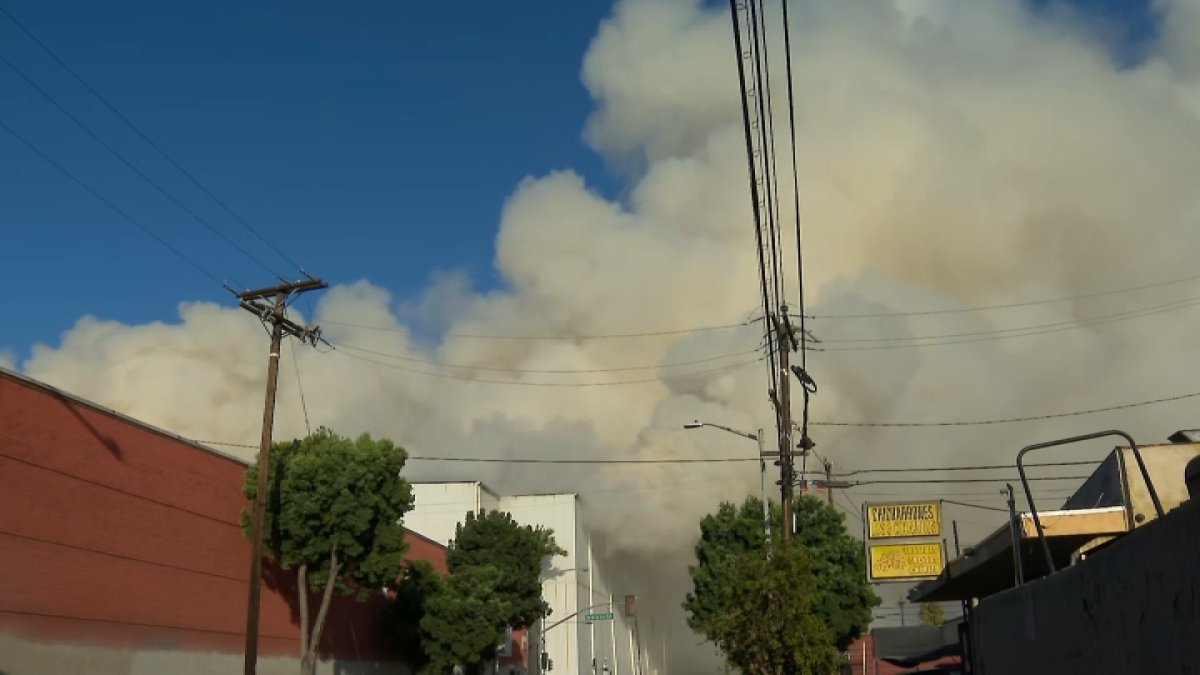
A staggering 85,000,000 pounds of frozen food locked inside a burning, 500,000-square-foot commercial facility has forced Los Angeles Mayor Karen Bass to declare a local state of emergency. The stubborn blaze in the Boyle Heights neighborhood, which ignited on Wednesday afternoon, has resisted traditional firefighting methods for four consecutive days, cloaking the Los Angeles basin and neighboring San Gabriel Valley communities in a persistent, hazy chemical odor.

The Bottom Line
- The fire broke out at 2:35 p.m. on Wednesday, June 17, 2026, at a cold-storage warehouse operated by Lineage at 1400 S Los Palos Street.
- A compromised ammonia line pressurized an off-gassing of toxic chemicals early on, forcing around 110 firefighters into a defensive posture.
- Crews are battling deep smoldering pockets inside dense foam insulation lining the corrugated steel walls of the building.
- A local state of emergency has been declared to secure state cleanup resources as fire crews transition from hazardous materials to biohazard mitigation from 85 million pounds of spoiling food.
- Air quality advisories for particle pollution remain active through 12:30 p.m. Sunday across a massive swath of Southern California, from West Hollywood to Pasadena.
Breaking It Down
The initial emergency call rang out at 2:35 p.m. on Wednesday, June 17, 2026, sending units to the sprawling cold-storage facility owned by Chill Build LLC and operated by Lineage (formerly Lineage Logistics). First-responding crews discovered heavy fire visible from the roof of the 1,000-foot by 500-foot structure, which was covered in a massive solar panel array. Firefighters initially attempted an offensive inside attack, but the operation shifted dramatically within 15 minutes. A critical ammonia line ruptured, releasing a dangerous, pressurized burst of toxic and flammable gas that forced firefighters to immediately evacuate the roof and interior.
Because the interior was inaccessible and the roof began to sag, the Los Angeles Fire Department took the highly unusual step of deploying helicopters to execute tactical water drops on the burning building. Tenant-operator Lineage later indicated it believes the fire originated while third-party contractors were actively testing the rooftop solar array. While the main body of the fire appeared under control within six hours on Wednesday night, deep pockets of fire trapped inside a freezer container reignited on Thursday, triggering an extended, multiday battle against recurring flare-ups.

By Saturday evening, June 20, shifting wind conditions triggered another large flare-up inside the building. LAFD Chief Deputy Jon O’Brien reported that deep pockets of fire remain buried under structural debris and solar panels. To reach these zones without risking lives, crews have deployed an LAFD structural firefighting robot alongside heavy ground equipment to pump massive volumes of water into the facility. Meanwhile, hazardous materials teams executed a high-risk operation to isolate and remove 56 of the facility’s 60 lithium-ion battery-powered forklifts, successfully mitigating a severe risk of thermal runaway.
Why This Matters
LAFD Chief Jaime Moore described the facility as acting "like a giant cooler," explaining that the exterior corrugated steel walls are filled with extremely dense foam insulation that burns slowly and generates vast quantities of thick smoke. While officials confirmed that air monitoring by the South Coast Air Quality Management District (AQMD) has not detected toxic chemical levels above health thresholds, the focus has shifted toward a massive biohazard threat. With power cut and the building burning, the 85 million pounds of frozen food inside are spoiling rapidly.
The emergency declaration by Mayor Karen Bass officially activates the city’s emergency response framework and opens the door for state assistance from Gov. Gavin Newsom. The smoke has spread far beyond East Los Angeles, dropping a visible haze and chemical odor over downtown, West Hollywood, Culver City, Pasadena, and South Pasadena. L.A. County Health Officer Muntu Davis warned that fine particulate pollution (PM2.5) remains a significant health concern for sensitive individuals, including those with respiratory illnesses, heart conditions, or pregnant residents.
The incident has also brought renewed scrutiny to Lineage, which operates 500 facilities worldwide as the world's largest temperature-controlled food supply-chain company. State records show that the California Occupational Safety and Health Administration (Cal/OSHA) opened an investigation into the site on the day the fire started. Furthermore, this is not the first emergency at this specific address; LAFD crews previously responded to an hour-long solar-panel fire at the same facility in August 2024.
What Comes Next
Ground crews will continue suppression and overhaul operations throughout the night, monitoring for structural wall instability caused by the extreme volume of water applied to the building. The South Coast AQMD particle pollution advisory remains strictly in effect until at least 12:30 p.m. on Sunday, June 21, though officials note that further extensions are highly probable as long as the facility smolders. Heavy environmental monitoring of both air quality and runoff water will remain continuous as the city transitions into the hazardous waste and biohazard cleanup phase.
Frequently Asked Questions
What caused the Boyle Heights warehouse fire?
While the incident remains under official investigation, tenant-operator Lineage stated that it believes the fire began on the roof while third-party contractors were testing the building’s solar panel array.
Why has the fire burned for so many days?
The 500,000-square-foot facility is built like a giant cooler with corrugated steel walls packed with thick foam insulation. This dense insulation feeds slow, buried fires that are incredibly difficult for water to reach beneath collapsed roofing and solar panels.
Is the smoke from the warehouse fire toxic?
Air monitoring by the LAFD and South Coast AQMD has confirmed that there are no extra toxic chemicals in the air beyond ordinary structure fire smoke. However, the smoke contains fine particulate matter (PM2.5) that can severely irritate eyes, noses, and lungs, and worsen pre-existing heart or respiratory conditions.
Are there shelters open for residents affected by the smoke?
Yes. Two local relief centers equipped with masks and air filters have been opened to assist residents: the Pecan Recreation Center at 145 S. Pecan St. and City Terrace Park at 1126 N. Hazard Ave.
What should residents do to protect themselves from the air quality?
Health officials recommend staying indoors with windows and doors securely closed, running air conditioning on recirculate, or utilizing an air purifier. If you must spend extended time outdoors in smoke-impacted areas, you should wear a well-fitting N95 or KN95 mask.