
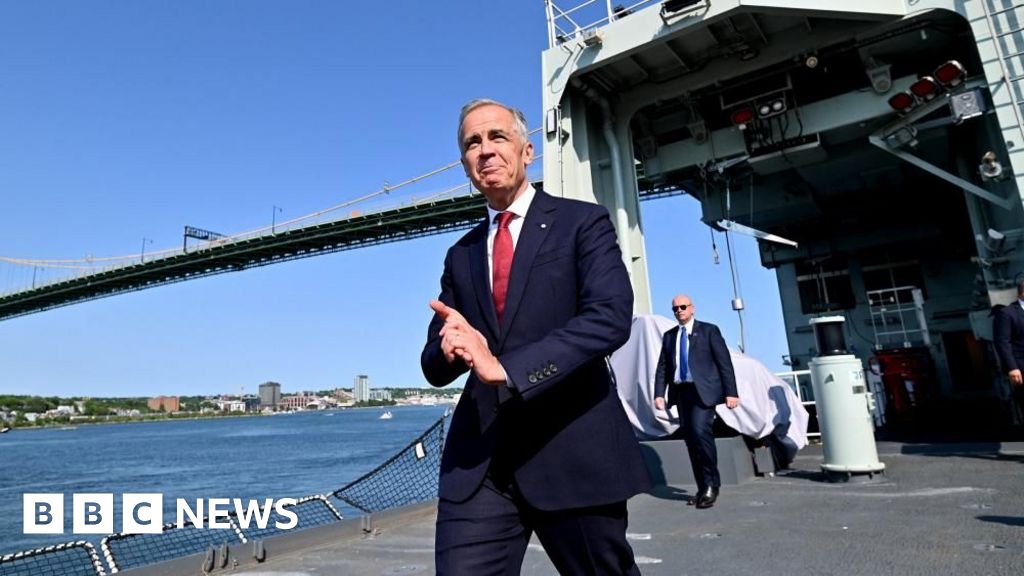
HALIFAX, Nova Scotia — Prime Minister Mark Carney announced Monday that Canada has selected German defense firm ThyssenKrupp Marine Systems as the preferred supplier to build a brand-new fleet of up to 12 stealth submarines for the Royal Canadian Navy. This massive multi-billion-dollar initiative, known officially as the Canadian Patrol Submarine Project, marks the single largest military procurement in Canadian history. The strategic decision comes directly ahead of Carney's departure for a high-stakes NATO summit in Ankara, Turkey, where defense investments and alliance burden-sharing top the global agenda.
The sweeping acquisition addresses a critical vulnerability in North American maritime defense, as the federal government confirms that only one of Canada’s four existing Victoria-class submarines is currently seaworthy. Facing an increasingly tense geopolitical climate, Canadian officials are growing heavily concerned about climate change warming Arctic waters and opening up new, unmonitored transit routes for potential adversaries. By locking in a shared submarine platform with Germany and Norway, Ottawa is aiming to establish a deep, long-term strategic and economic partnership with Europe while building up its own domestic industrial base.
The Full Story
The road to Monday's historic announcement followed an intense, multi-stage bidding war between Europe and Asia. Canada initially launched its search for a contractor in July 2024 to replace its aging fleet of secondhand vessels bought from Britain back in 1998. By August 2025, the government narrowed the competitive field down to two primary contenders: Germany's TKMS, offering its advanced 212CD model, and South Korea’s Hanwha Ocean, which pitched its substantially larger KSS-III Batch-II submarine. Both manufacturing giants spent months aggressively lobbying in Canada, offering major tech transfers and billions in domestic economic incentives.
Ultimately, the enduring pull of NATO alignment and transatlantic integration won out. According to data obtained via Germany's DPA news agency, the initial purchase of the submarines and immediate support is estimated to be worth around €20 billion, or roughly $22.8 billion. However, because the overarching contract includes approximately half a century of long-term operational maintenance and logistics, the final total bill over three decades could exceed $70 billion to $100 billion. The newly selected 212CD vessels will be manufactured at TKMS shipyards in Kiel and Wismar in northern Germany, a move expected to create up to 1,500 manufacturing jobs locally.
While the German defense sector celebrates, the fallout from the decision has triggered immediate economic shockwaves across the Pacific. Shares of South Korea's Hanwha Ocean plummeted approximately 23% in Tuesday trading following the announcement. The loss also brought a sudden halt to several major industrial projects planned inside Canada. Hanwha formally confirmed Monday evening that it is completely withdrawing from its multi-million-dollar partnership with Mohawk College and Ontario Shipyards in Hamilton, which was explicitly dependent on winning the submarine bid. A separate $345 million memorandum of understanding to construct a structural steel beam mill with Algoma Steel in Sault Ste. Marie has also been terminated.
Central Figures
- Mark Carney: The Prime Minister of Canada, who pushed the massive defense project on an expedited timeline to hit NATO commitments.
- Friedrich Merz: The German Chancellor, who welcomed the deal as a powerful signal for transatlantic partnership and a cornerstone for recovering Germany's domestic economy.
- Boris Pistorius: The German Defense Minister, who noted that the deal creates a highly integrated three-nation fleet consisting of Germany, Norway, and Canada.
- David McGuinty: Canada's Defense Minister, who emphasized that the new vessels will ensure security across Canada's vast coastline.
What This Means
For ordinary citizens and local industries across North America, this deal represents a monumental pivot in how continental security is managed. For the first time since the fall of the Berlin Wall, Canada has officially boosted its defense spending to meet the mandatory NATO threshold of 2% of GDP, with an ambitious legislative commitment to hit 5% by 2035. This dramatic funding ramp-up provides crucial political leverage as US President Donald Trump continues to apply heavy pressure on the alliance's 32 member nations to increase their military self-reliance.
What's interesting is that the move also highlights a deliberate strategy by Ottawa to diversify its defense dependencies away from the United States. While Canada remains heavily integrated into the binational NORAD framework—and has committed to purchasing 18 American-made F-35 fighter jets—recent trade and political frictions have prompted Canadian planners to look to European vendors. Beyond the submarine project, Canada is currently weighing a massive purchase of 72 Saab-made Gripen warplanes from Sweden to further modernize its air force.
What to Expect
The Canadian government and TKMS will now enter into formal, detailed contract negotiations to finalize the legal and technical arrangements of the procurement. Federal officials stated that they intend to officially conclude all contracting no later than the end of 2027. Because the current Victoria-class fleet can only remain operational into the mid-to-late 2030s, the timeline is tightly compressed. Production will begin on an accelerated schedule, with the first four brand-new stealth submarines explicitly scheduled for delivery to the Royal Canadian Navy by 2034.
Frequently Asked Questions
Why did Canada choose Germany over South Korea for the submarine contract?
Canada selected Germany's TKMS because its 212CD submarine platform is shared with Norway, offering a low-risk, fully NATO-aligned solution. This allows for seamless information sharing, shared training, and joint maintenance networks across the North Atlantic and Arctic oceans. South Korea is not a NATO member country.
How much is the Canadian submarine deal actually worth?
The initial purchase of the 12 submarines and immediate technical support is estimated at roughly €20 billion, or $22.8 billion. However, when factoring in fifty years of maintenance, training, and operational logistics, the total lifetime cost of the program is projected to reach between $70 billion and $100 billion.
What will happen to the local Canadian partnerships Hanwha Ocean set up?
Hanwha Ocean has completely withdrawn from its training hub agreements with Mohawk College and Ontario Shipyards, stating that the project has stopped. However, Ontario Shipyards confirmed it will continue to construct its planned naval training vessel on speculation alongside the college without South Korean financial backing.
When will the Royal Canadian Navy receive the new submarines?
Formal contract negotiations are scheduled to wrap up by the end of 2027. Under the current expedited defense framework, the first four conventionally powered submarines are scheduled to be delivered to Canada by 2034, with the full fleet replacing the older Victoria-class vessels by the mid-2030s.