
Senator Bernie Moreno announced plans on Thursday to introduce a bill next week to sanction Canada and its government officials as hazardous wildfire smoke blankets the northern United States. The proposed legislation comes amid growing bipartisan and international friction over air quality indexes exceeding 500 in multiple Midwest cities. Thick plumes from massive blazes in northern Ontario have disrupted everyday life across the Great Lakes and Mid-Atlantic regions, forcing vulnerable residents indoors and sparking unprecedented political threats from Capitol Hill.

The Full Story
The conflict escalated rapidly on July 16, 2026, when Senator Moreno (R-Ohio) shared an image of a hazy, deserted boulevard in Cleveland, declaring his intention to penalize America's northern neighbor for the recurring environmental crisis. Concurrently, four Republican members of the House of Representatives from Michigan—Reps. Jack Bergman, John James, Lisa McClain, and John Moolenaar—dispatched a sharply worded joint letter to Canadian Prime Minister Mark Carney. The lawmakers explicitly warned that American patience has run out after three consecutive years of drafting formal complaints regarding transboundary air pollution. They went so far as to suggest that U.S. agencies might explore direct cross-border intervention and fuel reduction management if Canada fails to control its northern forests.
On the ground, the immediate impact has hit local infrastructure and public health systems hard. In Wayne County, Michigan, officials scrambled to distribute approximately 70,000 face masks to elderly residents, while multiple businesses in downtown Detroit shuttered their doors due to toxic air conditions. The haze has completely obscured iconic landmarks like the Statue of Liberty and the Empire State Building in New York City, prompting the activation of air quality emergency protocols and the opening of hundreds of municipal cooling centers. What's interesting is how quickly the rhetoric has shifted from collaborative environmental management to national sovereignty debates, with some regional politicians like Michigan State Senator Aric Nesbitt even floating provocative jokes about annexation online if forest management policies do not change immediately.
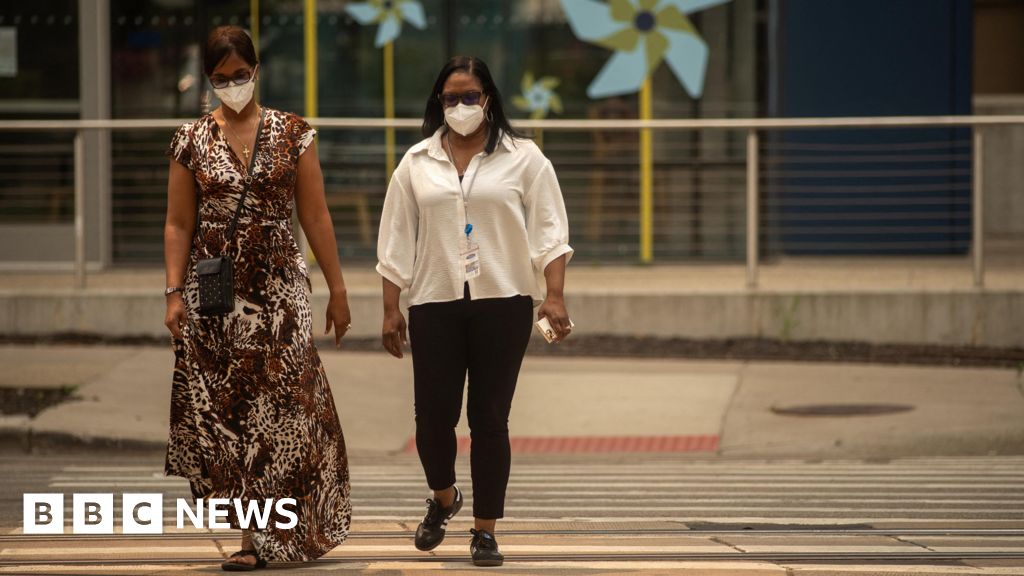
Canadian officials have pushed back against the wave of American criticism. Speaking from London, Ontario, Prime Minister Mark Carney brushed off the threats of sanctions and directly critiqued American climate policy, asserting in French that climate change is everyone's responsibility, including the United States. Meanwhile, Ontario Premier Doug Ford defended his province's localized emergency response, stating that over 150 fire crews are active on the ground and pledging to spend whatever it takes to contain the blazes. However, local indigenous leaders face far direr circumstances; Namaygoosisagagun First Nation Chief Helen Paavola revealed that an aerial flyover showed her remote northern Ontario community has been burnt to ashes, forcing dozens of residents to flee for their lives by boat.
The Main Players
- Senator Bernie Moreno (R-Ohio): U.S. Senator spearheading the legislative push to sanction Canadian officials over smoke pollution.
- Prime Minister Mark Carney: Canadian leader who rejected the U.S. accusations, shifting focus toward broader international climate responsibilities.
- Michigan Congressional Delegation: Reps. Jack Bergman, John James, Lisa McClain, and John Moolenaar, who authored the joint warning letter demanding forest-management accountability.
- Premier Doug Ford: Leader of Ontario who dismissed criticism of his government's fire mitigation spending and deployment.
- Chief Helen Paavola: Head of the Namaygoosisagagun First Nation, whose community was completely leveled by the northern Ontario blazes.
Key Statistics
- There were 858 active wildfires burning across Canada as of mid-July, with 136 separate fires active in Ontario's northwest region alone.
- Out of the active blazes in northwestern Ontario, 63 are currently classified by provincial forest fire officials as completely out of control.
- The total number of fires recorded in Ontario so far this year stands at 483, a steep increase from the 351 reported by this date last year.
- Wayne County emergency services distributed roughly 70,000 protective face masks to seniors in response to Air Quality Index readings surging past 500.
What This Means
The escalating tension represents a significant diplomatic rift between two historically close allies over climate governance and environmental management. For everyday families living across the American Midwest and Northeast, this political standoff is an immediate healthcare emergency. Local hospitals are reporting an influx of children, older residents, and dialysis patients requiring urgent treatment for respiratory stress caused by high-density particulate matter. The financial toll is also mounting as outdoor summer events face widespread cancellations, municipal governments absorb the costs of emergency mask distributions, and commercial operations suffer localized closures due to hazardous workplace environments.
What to Expect
Senator Moreno is confirmed to formally introduce his sanctions bill in the U.S. Senate next week, which will force lawmakers to take an explicit stance on penalizing Canadian administrative failures. On the environmental front, meteorologists and forecasters warn that poor air quality and dense low-level haze will persist through the upcoming weekend, with conditions expected to drift further south into northern Virginia before any atmospheric relief arrives. Emergency management officials in Ontario are currently coordinating with federal authorities in Ottawa to finalize rapid 24-hour aircraft deployment protocols for ongoing evacuations of remote northern towns.
Frequently Asked Questions
Why is Senator Bernie Moreno introducing a bill to sanction Canada?
Senator Moreno announced the sanctions bill in response to heavy wildfire smoke from Canada drifting into the United States, which has caused dangerous air quality alerts across major cities like Cleveland, Detroit, and Chicago. He claims Canadian officials have failed to properly invest in preventive forest maintenance like forest thinning and prescribed burns.Which U.S. states are currently affected by the Canadian wildfire smoke?
Hazardous smoke and air quality alerts have spread across a massive portion of the northern United States, directly affecting communities in Michigan, Ohio, Illinois, Indiana, Minnesota, New York, Maryland, and reaching as far south as northern Virginia.
How has the Canadian government responded to the threats from U.S. lawmakers?
Canadian Prime Minister Mark Carney declined to directly answer the letter from congressional lawmakers, stating instead that fighting climate change is a shared global responsibility that includes the United States. Ontario Premier Doug Ford also defended his administration, noting that over 150 fire crews are currently deployed and battling the blazes.
What specific forest management failures are American lawmakers alleging?
The joint letter from the Michigan congressional delegation alleges that Canada has shown a chronic under-investment in critical forest mitigation tools, specifically pointing to a lack of forest thinning, inadequate fuel reduction programs, insufficient prescribed burns, and weak enforcement against arson.