
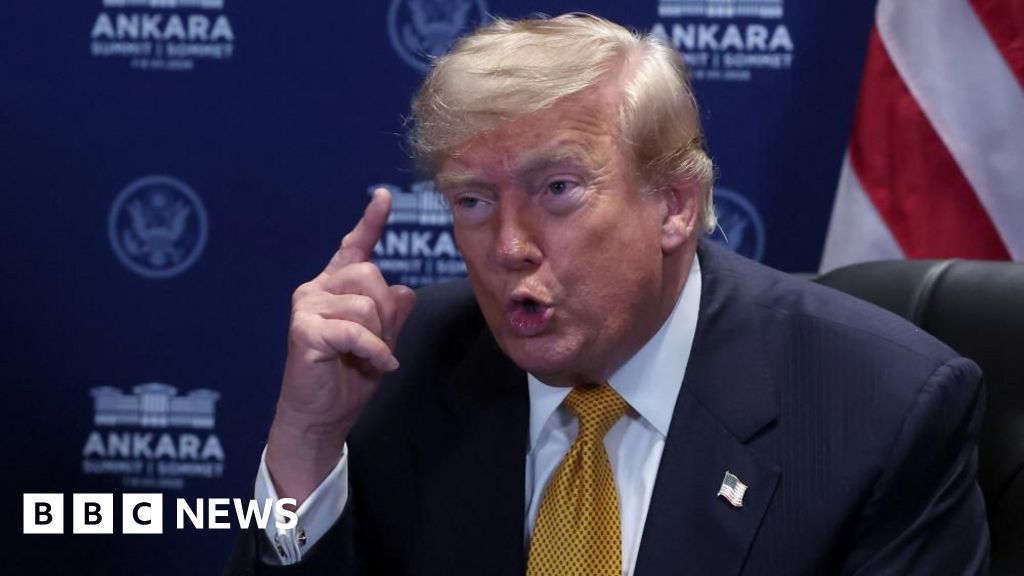
A staggering 6% spike in global oil prices shook financial markets Wednesday morning after U.S. President Donald Trump bluntly declared that the three-week-old ceasefire agreement with Iran is officially "over." Speaking from the NATO summit in Ankara, Turkey, Trump launched into a fiery tirade, branding Iran's leadership as "scum" and "cuckoo" following a violent overnight exchange of airstrikes and missile barrages across the Middle East. The sudden escalation effectively shatters the June 17 Memorandum of Understanding signed at the Palace of Versailles, thrusting the critical Strait of Hormuz back into a state of severe geopolitical peril.
The Bottom Line
- U.S. President Donald Trump declared the preliminary ceasefire agreement with Iran is "over" during a bilateral meeting at the NATO summit.
- The U.S. military launched powerful retaliatory strikes against more than 80 targets in Iran after three commercial shipping vessels were attacked in the Strait of Hormuz.
- Iran retaliated by firing ballistic missiles and drones at 85 U.S. military installations across Bahrain and Kuwait, prompting widespread missile alerts.
- The U.S. Treasury Department officially revoked the temporary license that allowed Iran to sell its crude oil openly on the global market in U.S. dollars.
- Global energy markets reacted instantly, with international benchmark Brent crude surging 5.92% to $78.55 per barrel, while West Texas Intermediate jumped 5.79% to $74.50.
Breaking It Down
The fragile peace dissolved rapidly late Tuesday when three commercial oil tankers transiting near the Strait of Hormuz came under fire in Omani waters. According to the U.S.-led Joint Maritime Information Center, the targeted vessels had deviated from routes dictated by Tehran, navigating closer to the coast of Oman instead. One vessel, a tanker transporting Qatari natural gas, caught fire off the coast after ignoring repeated warnings from Iranian forces. In immediate response, the U.S. Central Command unleashed what it described as "powerful strikes" targeting air defense infrastructure, radar facilities, and more than 60 small fast-attack boats operated by Iran’s paramilitary Revolutionary Guard Corps.
The battlefield widened dramatically within hours. Iranian state media reported heavy explosions across southern military installations, including the port city of Bandar Mahshahr—where a Revolutionary Guard navy member was confirmed killed by shrapnel—and the nuclear power plant complex in Bushehr. Seeking immediate retribution, Iran’s military command launched a coordinated barrage of ballistic missiles and drones toward neighboring Gulf states. Kuwaiti air defense systems intercepted two ballistic missiles and 13 drones, though falling shrapnel heavily damaged local electrical grids and cut power transmission lines. Sirens blared continuously in Bahrain as the U.S. Navy's 5th Fleet base faced consecutive waves of incoming projectiles.
Meanwhile, the diplomatic fallout materialized just as quickly as the military kinetic operations. Alongside the airstrikes, Washington officially terminated the sanctions waiver that had served as Iran’s primary incentive under the June pact, cutting off Tehran's short-lived ability to legally trade its crude oil in U.S. dollars. Western intelligence had long noted that Iran relied on selling under-market sanctioned oil to China, but the temporary lifting of penalties was intended to help widen its economic customer base. By pulling the license, the U.S. has effectively stripped Tehran of any immediate financial windfall, dealing a severe economic blow to a regime whose national budget relies on oil for roughly 50% of its revenue.
Why This Matters
The collapse of the truce carries profound economic and political consequences for the United States. Domestically, the sudden renewal of hostilities directly impacts American consumers via the energy markets. The Strait of Hormuz is the world's most critical energy artery; prior to the war, approximately 20% of global oil and natural gas supplies flowed through this narrow channel. Market strategists warn that prolonged instability and a renewed maritime blockade will likely revive steep inflation fears, driving up prices at the pump and compelling the Federal Reserve to maintain a highly hawkish interest rate stance. This economic pressure lands at a highly sensitive time for the Trump administration, with the crucial U.S. midterm elections rapidly approaching in November.
The escalation has also triggered intense friction within the NATO alliance during its high-stakes meeting in Turkey. President Trump openly aired his grievances regarding European allies, blasting them for refusing to allow American bombers to utilize European airbases for the mission. He singled out Spain for capping its defense budget and banned future trade discussions with Madrid, while also reviving his controversial rhetoric regarding U.S. control over Greenland. European Union foreign affairs chief Kaja Kallas warned that the fresh violence has severely complicated what were already "fraught talks" aimed at finding a permanent end to the Middle East conflict.

What makes the timing particularly volatile is that the hostilities reignited during the massive, multi-day state funeral for Iran’s former Supreme Leader Ayatollah Ali Khamenei, who was killed at the war's outset on February 28. While millions of mourners gathered in the Iraqi holy cities of Najaf and Karbala, political hardliners in Tehran seized on the atmosphere of grief to demand swift vengeance. Iran's new Supreme Leader, Ayatollah Mojtaba Khamenei, remains in hiding after being wounded in the initial strike that killed his father, leaving the country's military commands operating with heightened autonomy and deep hostility toward Western mediation.
What Comes Next
The geopolitical landscape remains deeply volatile as the official state funeral ceremonies for Ayatollah Ali Khamenei conclude with his final burial at the Imam Reza shrine in Mashhad on Thursday. While President Trump stated he would allow Middle East envoy Steve Witkoff and Jared Kushner to keep open lines of communication in Doha, Qatar, he firmly labeled continued diplomacy a "waste of time." Additionally, regional aviation authorities have issued urgent safety directives, with the European Union Aviation Safety Agency officially ordering all commercial airlines to completely avoid the airspace over Iran, Iraq, and Lebanon until at least August 31.
- Memorandum of Understanding (MoU)
- The 14-point preliminary peace framework signed on June 17 that established a temporary 60-day ceasefire and reopened the Strait of Hormuz.
- Strait of Hormuz
- A strategically vital narrow waterway between the Persian Gulf and the Gulf of Oman, through which one-fifth of global oil consumption passes.
- Sanctions Waiver
- A temporary legal authorization granted by the U.S. Treasury that permitted foreign entities to purchase Iranian crude oil using U.S. dollars without facing penalties.
Frequently Asked Questions
Why did the ceasefire between the US and Iran collapse?
The agreement collapsed after Iran attacked three commercial oil tankers in the Strait of Hormuz on Tuesday for ignoring localized routing demands. The U.S. responded with heavy airstrikes on 80 targets, prompting Iran to launch retaliatory missiles at U.S. military bases in Kuwait and Bahrain.
How does this conflict affect gas prices in the United States?
Because the Strait of Hormuz handles 20% of the world's traded oil, threats to shipping immediately constrain global supply. Following the strikes and President Trump's comments, Brent and WTI crude prices jumped by nearly 6%, which heavily threatens to increase domestic fuel costs and drive retail inflation higher.
Are peace negotiations between the US and Iran completely canceled?
Not completely, but their future is highly uncertain. President Trump explicitly stated that while he will allow his top negotiators to continue talking if they want, he personally views the diplomatic tract as a total waste of time because he believes the Iranian leadership cannot be trusted.
Is it currently safe to fly through Middle Eastern airspace?
No. Following the intense exchange of ballistic missiles and drones, the European Union Aviation Safety Agency (EASA) issued an official flight advisory directing all commercial airlines to entirely avoid the airspace over Iran, Iraq, and Lebanon until at least August 31, 2026.