
Millions of people across the Midwest, Northeast, and mid-Atlantic states are navigating a severe environmental crisis as heavy smoke from rampant wildfires pushes air quality to historic, hazardous lows. The massive plumes, originating from blazes in western Ontario and northern Minnesota, have plunged major metropolitan areas into a dense, toxic haze. Public health officials are urging residents to take immediate protective measures as the sweeping pollution triggers emergency health alerts across multiple states.

Setting the Scene
The current air pollution crisis stems from dozens of out-of-control wildfires devouring forests across northern Minnesota and adjacent portions of Ontario, Canada. The blazes initially ignited after a dry thunderstorm on July 6 brought more than 1,000 lightning strikes to a region already suffering from moderate to severe drought conditions. The situation rapidly deteriorated when an unprecedented upper-level ridge of high pressure baked the north-central U.S. and southern Canada, pushing temperatures past 100 degrees Fahrenheit (37.8°C).
What followed was an explosive fire spread fueled by dry forest vegetation, which included vast swaths of dead trees left behind by a previous spruce budworm infestation and a historic 1999 derecho windstorm. The extreme heat and strong winds fanned the flames, enabling the fires to breach containment lines and generate massive pyrocumulus clouds (giant thunderstorms spawned by the intense heat of fires) that reached the stratosphere, pumping millions of tons of fine particulate matter into the upper atmosphere.
Here's What Happened
By mid-July, northwest winds behind a series of sagging cold fronts began funneling the massive smoke plumes directly into the U.S. heartland and East Coast. The sheer volume of the pollution shattered long-standing environmental records. On Thursday, July 16, fifty official Environmental Protection Agency (EPA) monitors across five states—Minnesota, Wisconsin, Michigan, Illinois, and Ohio—registered 24-hour fine particulate matter (PM2.5) levels in the brown "Hazardous" range, which is the highest and most dangerous tier on the Air Quality Index.
The impact on major cities was immediate and severe. Detroit and Chicago temporarily claimed the titles of the most polluted major cities in the entire world. In Duluth, Minnesota, the 24-hour AQI hit an astronomical 934, completely obliterating its previous all-time record of 159 set in 2021. Further south, Chicago reached an unprecedented AQI of 511, and Detroit hit 490. In Washington, D.C., national landmarks like the Lincoln Memorial and the Washington Monument were obscured by an eerie, orange-hued fog, prompting Major League Baseball's Cleveland Guardians to postpone their game against the Pittsburgh Pirates in nearby Ohio.
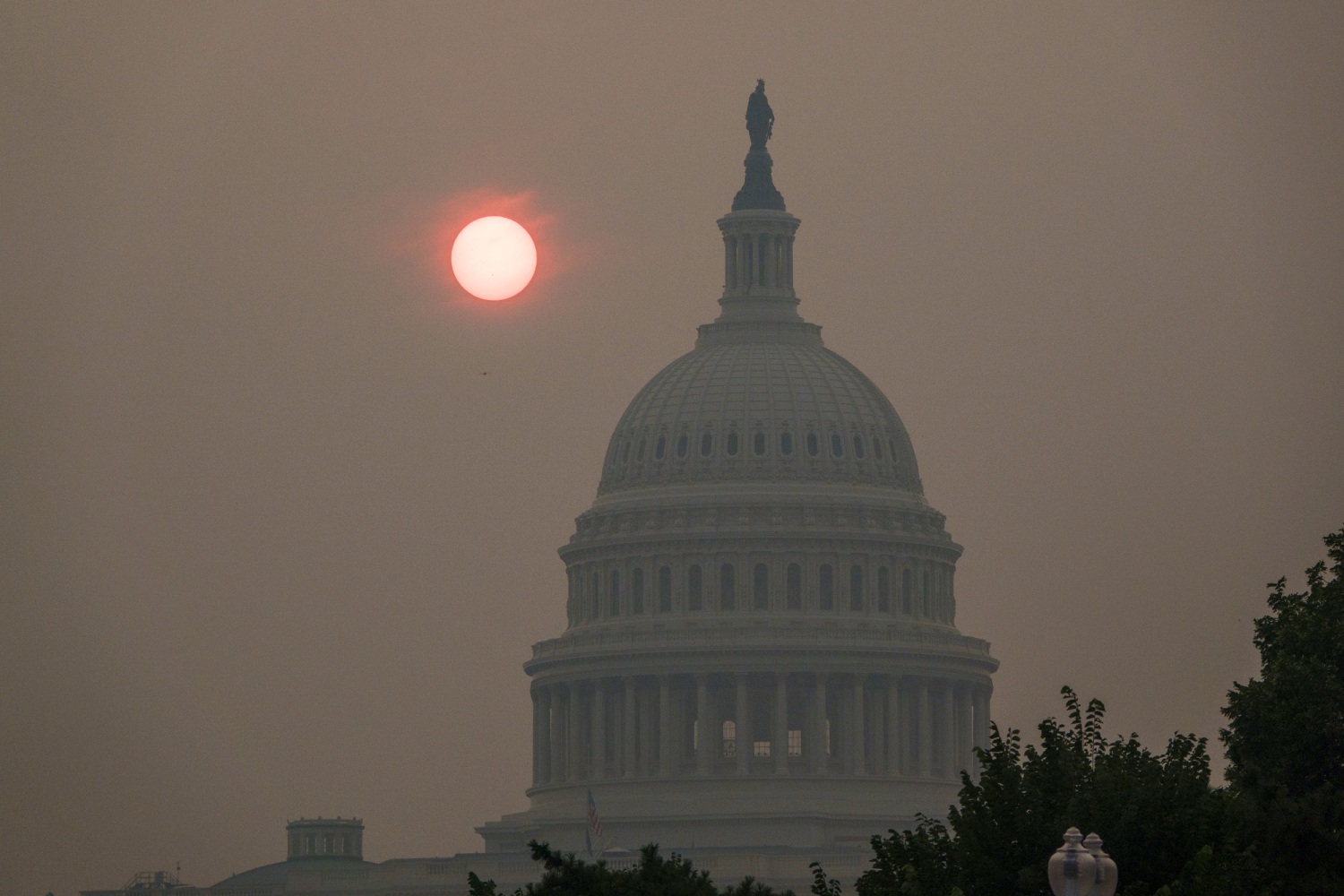
Public life ground to a halt as multiple states distributed free K95 face masks, canceled outdoor public events, and opened air-conditioned libraries and public buildings to serve as emergency clean-air shelters. Though subsequent weekend rainstorms and shifting winds brought temporary relief—dropping Chicago's AQI down to 156 by Sunday morning—forecasters warn that the reprieve will be short-lived. Meteorological models indicate a renewed pulse of heavy smoke will nosedive through the upper Midwest and sweep into the Northeast and parts of the South later this week.
Reactions & Responses
The persistent blanket of hazardous smoke quickly escalated into a political flashpoint. Former President Donald Trump took to social media to criticize Canada's forest management practices, threatening to impose additional tariffs to offset the economic and environmental damages hitting the U.S. The political friction drew a swift response from Canadian regional leaders who emphasized the collaborative nature of transboundary fire suppression.
If there’s some politicians out there chirping away, maybe what you should do rather than complain is send support, send help, because we have done the exact same thing for our American friends and that’s what you’re supposed to do.
Meanwhile, incident commanders are focusing entirely on containment as the scale of the disaster continues to grow. Firefighting crews have deployed heavy engines and extensive air support across the border states to protect vulnerable communities.
Fine particle levels are expected to reach the red air quality index (AQI) category, a level considered unhealthy for everyone.
The Bigger Picture
The health consequences of this historic pollution event extend far beyond temporary coughing or watery eyes. Wildfire smoke consists of a highly toxic mix of gases and microscopic PM2.5 particles that are small enough to bypass the body's natural defenses, such as nose hairs and mucus. Once inhaled, these particles penetrate deep into the lungs and enter the bloodstream directly, triggering severe systemic inflammation.
Medical data collected during a past multi-month smoke event in Yellowknife, Canada, revealed a full doubling of emergency department visits for asthma and a 50% increase in pneumonia diagnoses. Furthermore, a 2025 study evaluating a similar 2023 smoke event estimated it caused 33,000 premature deaths in the United States alone. Scientists emphasize that these intense fire cycles are a direct symptom of climate change; a warmer atmosphere accelerates the evaporation of moisture from vegetation, turning vast forests into highly combustible tinderboxes.
The Road Ahead
Currently, over 190 active fires are burning across 1.7 million acres in Ontario, with the vast majority officially categorized as out of control. South of the border, six large wildfires remain entirely uncontained across 60,000 acres in northern Minnesota's Boundary Waters park. Fire officials warn that several of these major smoke-producing blazes will likely burn for months, potentially lasting until the first seasonal snowfall arrives in October.
Residents across the Midwest and Northeast are strongly advised to monitor local air quality metrics daily via official channels before planning outdoor tasks. Health experts recommend checking home HVAC filters to ensure they are not clogged, using vehicles' air conditioning in recirculate mode to minimize smoke infiltration, and wearing high-quality respirators when outdoor exposure is unavoidable.
Frequently Asked Questions
Why is wildfire smoke more dangerous than standard dust or air pollution?
Wildfire smoke contains PM2.5 particulate matter, which consists of tiny toxins less than 2.5 microns in diameter. These particles bypass the nose and throat filters, traveling deep into lung tissues and directly entering the human bloodstream, where they can cause rapid inflammation, heart attacks, and strokes.
Which states have experienced the worst air quality during this event?
Five states recorded official "Hazardous" air quality levels on the EPA index: Minnesota, Wisconsin, Michigan, Illinois, and Ohio. Three additional states—New York, Pennsylvania, and Indiana—registered "Very Unhealthy" purple alerts.
How long are these smoky conditions expected to last in the US?
While regional wind changes and passing storms provide temporary relief, weather models indicate a third major wave of smoke will push through the upper Midwest by Tuesday and reach the Northeast and parts of the South by Wednesday and Thursday. Several major fires are projected to burn until October.
What is the best way to protect myself from indoor smoke exposure?
Homeowners should check their central HVAC filters by holding them up to a light; if light cannot pass through, the filter is clogged and must be replaced. Additionally, keeping windows sealed and setting vehicle air conditioning systems to "recirculate" mode prevents outdoor pollution from being pulled inside.