
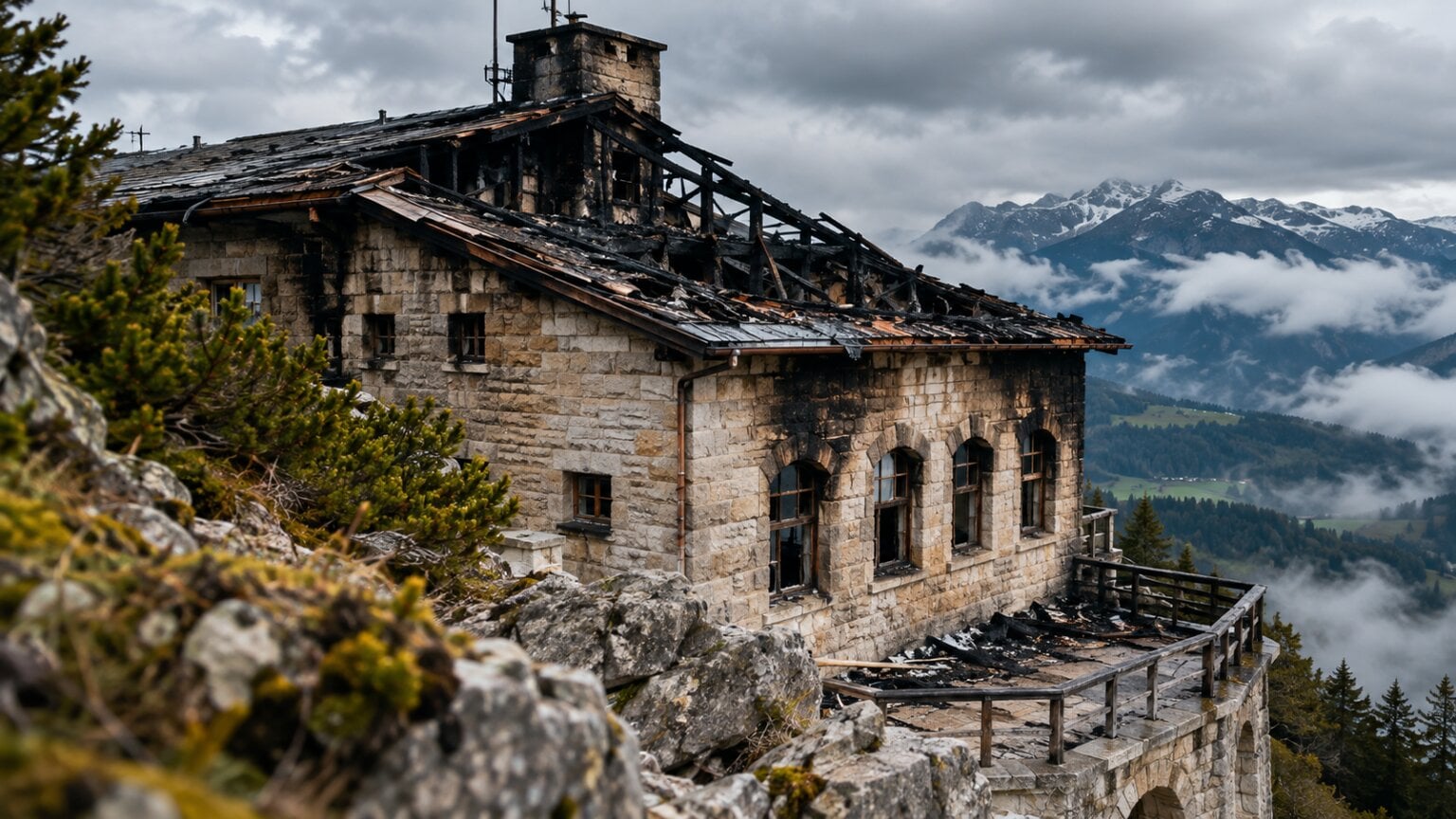
Scaffolding poles and emergency security barriers now clatter onto the jagged ridge of the Kehlstein mountain by helicopter, sealing off blackened stone where tourists once queued for Bavarian beer. The gutting of Adolf Hitler’s Eagle’s Nest retreat in an October arson attack has brought a simmering cultural debate out into the open. German authorities and historians are now deadlocked over whether to rebuild the Alpine landmark or level its scorched masonry to the ground.

The Result
The immediate fallout from the blaze during the evening of 23 October has left the historical mountaintop complex, known in German as the Kehlsteinhaus, classified by Bavarian police as 'largely destroyed'. Investigators quickly moved against a suspect, confirming that a 33-year-old man with a history of mental illness was detained in a secure psychiatric hospital on suspicion of arson. While the blaze caused millions of euros in property damage across the structure, emergency services recorded zero injuries.
Crucially for researchers, the blaze spared the nearby Obersalzberg Documentation Centre, an educational museum opened in the 1990s to contextualise Nazi crimes. The fire consumed the restaurant areas and summit rooms situated 1,834m (6,017ft) above sea level, leaving the Bavarian state government holding title to an unstable, roofless shell that drew tens of thousands of international visitors each season.
How the Vote Unfolded
Rather than a ballot at the voting booth, the contest over the mountain has split along sharp ideological lines among state officials, academic historians, and heritage conservators. Regional political leaders in Munich moved swiftly to back physical reconstruction, while independent historical scholars argued that rebuilding the property risks creating a sanctified destination for the extreme right.

The divide reflects wider tensions across Central Europe regarding Erinnerungskultur (the culture of remembrance). While municipal leaders point to the economic engine of Berchtesgaden tourism, academic panels warn that erecting pristine stonework over Nazi foundations distorts history at a delicate political moment.
Who Won and Why
State ministers established early momentum by ruling out an abandoned ruin. Joachim Herrmann, Bavaria’s Interior Minister, pushed the government towards rebuilding by arguing that leaving an open wound on the mountain creates an uncontrollable spectacle.
We can hardly leave a ruin standing there.
Heritage specialists quickly pushed back against an authentic replica. Markus Blume, Bavaria’s Minister for the Arts, insisted on Bavarian radio that any future works 'should not and must not cost the taxpayer anything', opening the door to private or non-profit funding models. Meanwhile, Sven Keller, head of the Obersalzberg Documentation Centre, cautioned against simply razing the summit, recalling that the post-war demolition of Hitler’s nearby Berghof residence in 1952 failed to erase the area from extremist interest.
From the academic side, British historian Richard J. Evans of the University of Cambridge called for the mountain to be cleared of rubble and returned to nature, pointing to how Berlin dealt with Hitler’s underground bunker by sealing it in concrete beneath an ordinary children’s playground.
What It Means for Policy and Power
The blaze has forced Bavarian authorities to convene a formal specialist panel comprising figures from construction engineering, monument conservation, and Holocaust remembrance. For British observers and travellers who regularly visit Bavaria, the resolution will determine whether the historic brass lift and mountain terrace reopen as an altered educational installation or remain closed indefinitely.
Allowing a complete rebuild risks accusations of sanitising totalitarian propaganda architecture, whereas leaving blackened stone invites unsupervised trespassing along Alpine walking tracks. The controversy mirrors recent dilemmas in Austria, where authorities converted Hitler’s birth home in Braunau am Inn into a police station to neutralise far-right interest.
What Happens Next
The immediate priority remains the structural stabilisation of the charred masonry before winter conditions shut down high-altitude Alpine access. Over the coming months, the advisory committee will deliver recommendations on whether to integrate modern architectural elements into the surviving shell — an approach backed by contemporary historian Isabel Heinemann to visually document the fire rather than recreate pre-war designs.
Police investigators have not disclosed an official motive for the arson attack as forensic reports continue. Until ministerial decisions and planning approvals conclude, public transport up the mountain and access to the panoramic ridge remain completely blocked.
Frequently Asked Questions
What was the Eagle’s Nest originally built for?
Known in German as the Kehlsteinhaus, it was constructed by the Nazi regime in 1938 at 1,834 metres altitude as a mountaintop retreat and reception venue used by Adolf Hitler and high-ranking officials.
When did the fire happen and was anyone hurt?
The fire broke out on the evening of 23 October. No injuries were reported, but the building was largely destroyed.
Who is suspected of starting the fire?
A 33-year-old man with a history of mental illness was detained in a secure psychiatric facility on suspicion of arson, though authorities have not released a motive.
Is the site currently open to the public?
No. The site has been sealed off with barriers and scaffolding transported by helicopter while officials and historians decide whether to rebuild or preserve the remains.