Large crowds cheered at the Starbase launch site in Boca Chica, Texas, as a 171ft bullet-shaped spacecraft descended from orbit into the giant mechanical arms of its launch tower. On Saturday at roughly 21:20 GMT (15:20 local time), SpaceX caught the upper stage of its Starship megarocket on its return to Earth for the very first time. While the mission fell short of an ambitious double catch after the lower booster exploded in the Gulf of Mexico on Friday, the upper stage completed 14 orbits around Earth before landing safely.

What Was Achieved
SpaceX achieved a major engineering milestone during Starship's 15th test flight by successfully catching the upper stage—also referred to as the Ship—directly at its Texas launch tower. Standing over 400 feet tall and weighing more than 5,000 tons at liftoff, Starship is the largest interplanetary rocket in the SpaceX fleet, and this test marked only the second time the craft has entered Earth's orbit.
Originally, SpaceX planned a historic double-catch mission to recover both halves of the rocket intact rather than retrieving hardware from the sea. However, minutes after Friday's takeoff, the lower booster stage—known as Super Heavy—diverted from its path and burst into flames just above the Gulf of Mexico. Despite losing the booster, which SpaceX had previously caught on three prior missions, catching the orbital upper stage represents a crucial step toward rapid rocket reusability.
It was doing what it was supposed to do. Basically, it detected that the booster was not in the place it was supposed to be to proceed with a catch.
How It Works
Starship operates as a two-stage system designed to return entirely to its launch pad for rapid turnaround, much like a commercial airliner. During ascent, the lower Super Heavy booster relies on Raptor engines to power the stack toward space before separating from the 52-metre (171ft) upper stage.
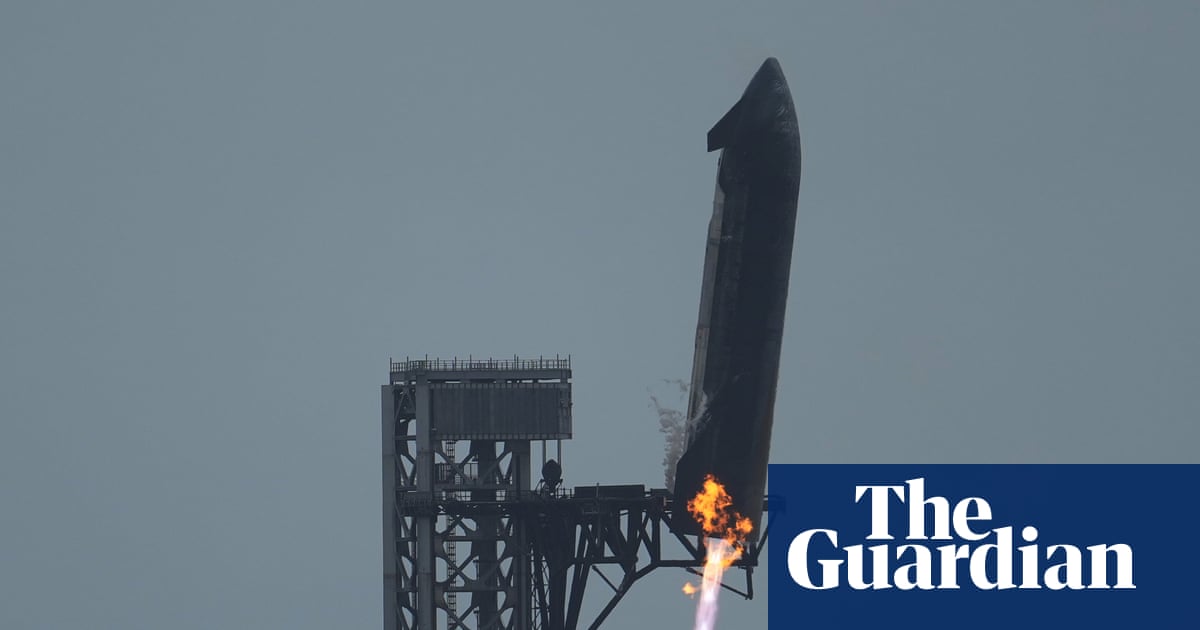
To bring the upper stage back from orbital velocity, SpaceX relies on automated flight software and precision engine burns to guide the falling craft directly between two giant mechanical arms—nicknamed chopsticks—mounted on the launch tower. That same safety software prevented a tower collision on Friday when the guidance, navigation and control system aborted the Super Heavy catch after detecting the booster was off-target and, according to SpaceX chief executive Elon Musk, slightly low on fuel.
- Super Heavy
- The lower booster stage powered by Raptor engines that lifts the Starship stack off the launchpad toward orbit.
- Chopsticks
- Giant mechanical arms attached to the Starbase launch tower designed to catch returning rocket stages mid-air.
- Guidance, Navigation and Control (GNC)
- The automated onboard system that monitors trajectory and triggers an ocean diversion if a stage is out of position for a safe catch.
What Has Been Demonstrated
Across the 22.5-hour mission, SpaceX verified several operational capabilities beyond the tower catch itself. According to BBC coverage of the Texas landing, the upper stage arrived a few minutes behind schedule on Saturday afternoon, yet executed a soft landing straight into the tower's clutch.

- Orbital endurance: The upper stage completed 14 orbits around Earth during a flight lasting roughly 22 to 22.5 hours before re-entering the atmosphere.
- Commercial payload deployment: While in orbit, the spacecraft successfully deployed 26 Starlink V3 satellites, directly expanding SpaceX's satellite internet network.
- Tower-top scale and precision: Point-of-view and time-lapse footage shared on X by Elon Musk from atop the tower confirmed the craft's intact alignment inside the mechanical arms, offering a closer look than media watch sites positioned far from the pad.
What Problems It Could Solve
Recovering both stages at the launchpad eliminates the time and expense of fishing hardware out of the ocean or building disposable rockets for every mission. Elon Musk has promoted full, rapid reusability as the primary way to bring down the high costs of spaceflight and enable launch frequencies closer to standard aviation.
In the near term, a functioning orbital Starship accelerates the rollout of heavier next-generation broadband hardware like the Starlink V3 satellites, which support global satellite internet services used across Britain and worldwide. Further ahead, the vehicle is central to Nasa's plan to return astronauts to the lunar surface in 2028, a programme for which the agency has contracted both SpaceX and Jeff Bezos's Blue Origin. Following Saturday's landing, Nasa administrator Jared Isaacman wrote on X that the flight moved the programme one step closer to the Moon.
What Still Needs to Happen
Before Starship can carry humans to the Moon or fulfill Musk's long-term goal of reaching Mars, SpaceX must prove it can catch both the Super Heavy booster and the upper stage on the same flight without fuel shortfalls or trajectory deviations. On a recent earnings call, Musk outlined plans to increase Starship test flights first to a weekly cadence and eventually to twice a week.
Demonstrating consistent, repeatable turnaround between flights remains essential before crewed deep-space missions can proceed. In the meantime, SpaceX is already preparing for its next scheduled launch, designated USSF-317.
Frequently Asked Questions
Did SpaceX catch both parts of the Starship rocket?
No. SpaceX caught the upper stage—known as the Ship—on Saturday, but the lower Super Heavy booster catch was aborted on Friday after guidance systems detected it was out of position and low on fuel, diverting it into the Gulf of Mexico.
How long was Starship in space before it was caught?
The upper stage spent roughly 22 to 22.5 hours in space, completing 14 orbits around Earth before returning to the launch tower in Boca Chica, Texas.
What payload did Starship carry on its 15th test flight?
During its orbital flight, Starship deployed 26 Starlink V3 satellites to expand SpaceX's satellite internet constellation.
Why does SpaceX catch rockets with mechanical arms instead of landing legs?
Catching the rocket stages directly at the launch tower allows SpaceX to recover the hardware intact without ocean recovery, aiming for rapid reusability that reduces launch costs and turnaround times.
How does this test affect Nasa's Moon landing plans?
Nasa has contracted SpaceX alongside Blue Origin to return humans to the lunar surface in 2028, making orbital flight and safe recovery key milestones toward human spaceflight certification.