
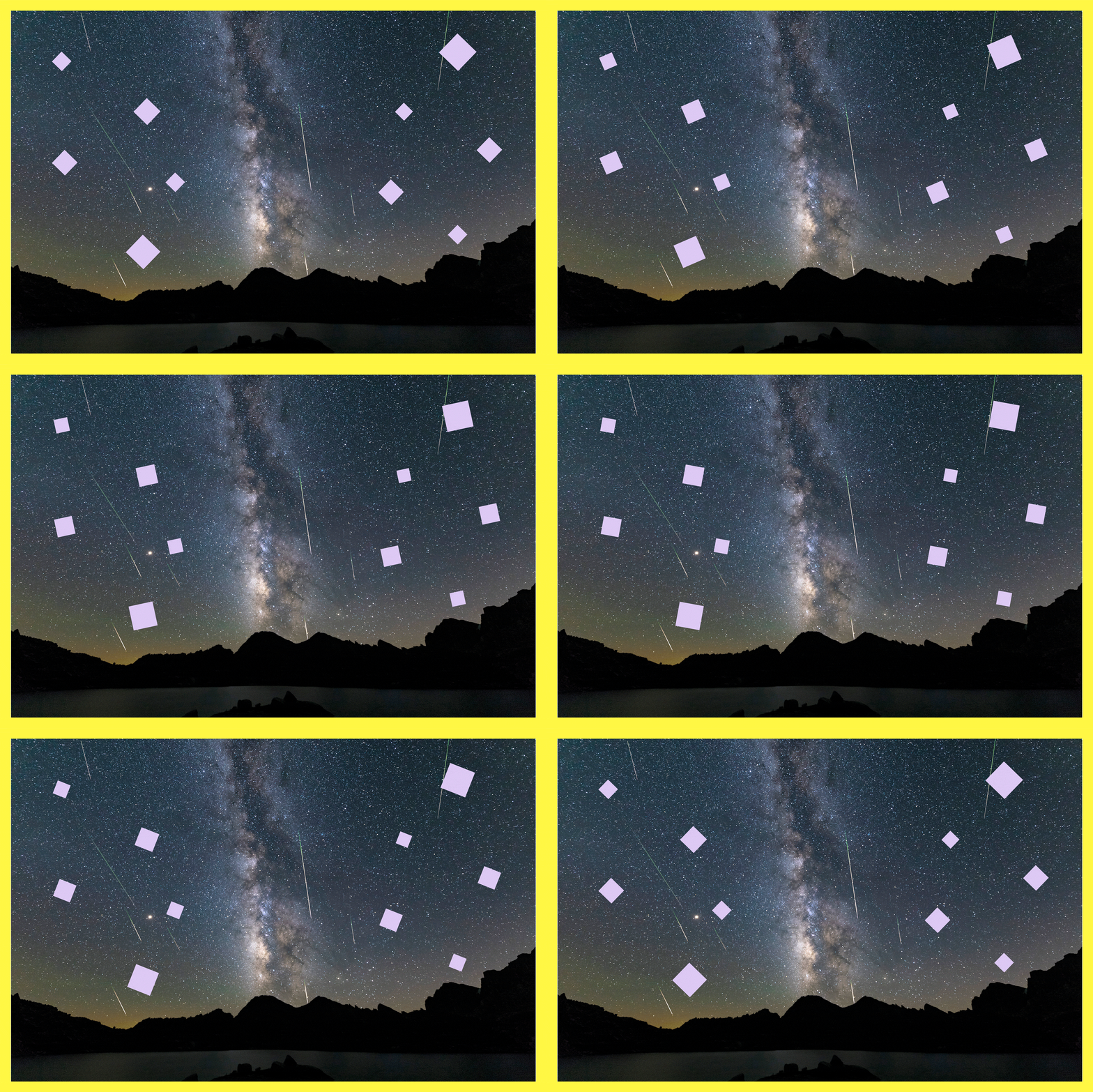
Under a completely dark night sky, up to 100 meteors per hour will streak across the atmosphere during the peak of the 2026 Perseid meteor shower. Astronomers from NASA and the American Meteor Society are calling this year’s display one of the best viewing opportunities in recent memory, primarily because the peak overnight from Wednesday, August 12, into Thursday, August 13, coincides perfectly with a new moon. With zero percent lunar illumination to wash out faint shooting stars, observers under dark rural skies can expect an unobstructed view of fast, bright meteors and long-lasting fireballs.
What Is Happening
The annual Perseid meteor shower is currently active and will run through August 24, but activity is rapidly building toward its maximum intensity. During the peak window on August 12 and 13, Earth will cross the dense central core of a debris stream left behind in space. Under ideal conditions with no light pollution, stargazers can witness 50 to 100 meteors every hour. Even in areas with mild light pollution, the absolute absence of moonlight this year will ensure that far more faint streaks remain visible compared to last year, when an 84% full moon obscured much of the sky.
The Background
To understand why this celestial event occurs every summer, it helps to examine the cosmic origin of the debris. As Earth travels along its orbit each August, it passes directly through a cloud of dust, sand, and small pebbles shed by Comet 109P/Swift-Tuttle.

Discovered by American astronomers Lewis Swift and Horace Parnell Tuttle, the massive comet takes 133 years to complete a single orbit around the sun. Bruce Betts, chief scientist at the Planetary Society, notes that tiny specks of space dust enter Earth's atmosphere at extreme speeds—roughly 37 miles per second (59 km per second). The intense friction heats and vaporizes the particles, creating brilliant ionized gas trails high above the planet.
- Radiant Point
- The specific area in the night sky from which meteors appear to originate. For the Perseids, this point lies within the constellation Perseus.
- Fireball
- An exceptionally bright meteor caused by larger pieces of debris that explode in brilliant flashes of light and leave longer-lasting glowing trails.
The Latest Development
Skywatchers are gaining a rare alignment of multiple astronomical phenomena during the second week of August. In addition to the Perseid peak and the dark backdrop of the new moon, morning observers on August 12 will be treated to a six-planet alignment. Shortly before sunrise, Jupiter, Mercury, Mars, Uranus, Saturn, and Neptune will all sit above the horizon along the ecliptic path.
Meanwhile, astrophotographers and casual stargazers are making preparations across dark-sky destinations nationwide. Locations such as Spruce Knob and Dolly Sods Wilderness in West Virginia, along with Joshua Tree National Park and the San Gabriel Mountains near Los Angeles, are expecting heavy visitor traffic as travelers seek elevated spots above city smog and artificial lighting.

What It Means
For the average viewer in the US, catching the display requires minimal equipment—no telescopes or binoculars are necessary, as they narrow the field of view too much. Experts recommend heading out after midnight, lying flat on a blanket or reclining chair to view as much of the sky as possible, and allowing 20 to 30 minutes for eyes to adjust fully to the dark. Avoiding bright mobile phone screens is critical to maintaining night vision. While meteors radiate from the constellation Perseus in the northeast, pointing cameras or looking toward the southwest often yields the longest fireball trails as the particles burn up overhead.
What Remains Unclear
While the orbital mechanics of Comet Swift-Tuttle's debris trail are precise, several variable factors dictate the exact experience for local viewers:
- Local cloud cover and summer atmospheric haze remain unpredictable until hours before viewing.
- Exact hourly rates for city dwellers depend heavily on proximity to direct glare from streetlights and urban light pollution.
- The visibility of faint meteors in the planetary parade before dawn will depend on clear horizons to spot low-lying planets like Mercury and Jupiter.
Frequently Asked Questions
When is the absolute best time to watch the Perseids?
The shower reaches its peak overnight from Wednesday, August 12, into the pre-dawn hours of Thursday, August 13. Peak activity occurs between midnight and dawn.
Do I need a telescope or special equipment to see meteors?
No. Binoculars and telescopes restrict your field of view. The best way to watch is with the naked eye, looking at a wide expanse of open sky.
Why is the 2026 Perseid meteor shower considered special?
The 2026 peak coincides with a new moon, meaning zero lunar glare will wash out the night sky, creating optimal conditions to see faint meteors and fireballs.
Where do the meteors come from?
The Perseids are caused by Earth passing through a stream of space debris left behind by Comet 109P/Swift-Tuttle as it orbits the sun.
How many meteors can I expect to see per hour?
Under dark rural skies away from light pollution, viewers can see up to 100 meteors per hour. Typical rural viewing yields roughly 30 to 50 per hour.
What other events are happening in the sky this week?
A rare six-planet alignment featuring Jupiter, Mercury, Mars, Uranus, Saturn, and Neptune will be visible shortly before sunrise on August 12.