Recent Earthquake Activity in Utah Draws Attention
Reports of a light earthquake in northern Utah have prompted renewed public attention to seismic activity along the Wasatch Front. While no damage or injuries were reported, the event has highlighted ongoing questions about earthquake frequency, preparedness, and what small tremors can signal in a geologically active region.
Main Topic Overview
Utah sits near several active fault systems, most notably the Wasatch Fault, which has produced significant earthquakes in the distant past. Smaller, shallow earthquakes are periodically felt across Utah County and the Salt Lake Valley. These events are typically minor, but they often trigger public discussion about seismic risk, emergency readiness, and the role of monitoring agencies in tracking and explaining earthquake behavior.
This is not the first time a minor quake has been felt in this area. Previously in 2020, a stronger magnitude 5.7 earthquake near Magna caused widespread damage and raised awareness statewide. Against that backdrop, even modest tremors tend to attract close attention from residents and local media.
News Coverage
Magnitude 3.5 earthquake shakes Utah County near Saratoga Springs

KUTV reported that a magnitude 3.5 earthquake was detected near Saratoga Springs in Utah County. According to the report, the quake was shallow and widely felt by residents, though it did not result in structural damage. Experts quoted in the coverage emphasized that earthquakes of this size are common in the region and generally serve as reminders of underlying fault activity rather than indicators of an imminent larger event. The report places the quake within the broader pattern of frequent low-magnitude seismic movement in northern Utah.
Earthquake reported near Saratoga Springs

KSLTV focused on eyewitness accounts from residents who reported feeling shaking during the earthquake near Saratoga Springs. The coverage highlights how even relatively small earthquakes can be noticeable in rapidly growing communities with dense housing. Seismologists referenced in the article explained that such quakes are routinely recorded by monitoring networks and help scientists refine their understanding of local fault behavior. This reporting contributes to the broader trend of public awareness around everyday seismic activity.
Did you feel that? 3.4 magnitude earthquake shakes part of Utah

FOX 13 News Utah framed the earthquake as a shared public experience, noting social media reactions and reports from across the region. The article explains that a magnitude in the mid-3 range is unlikely to cause damage but can be clearly felt indoors. By placing the quake in context with Utah’s seismic history, the coverage reinforces expert guidance that preparedness planning should be based on long-term risk rather than individual small events.
Light magnitude earthquake recorded south of Salt Lake City
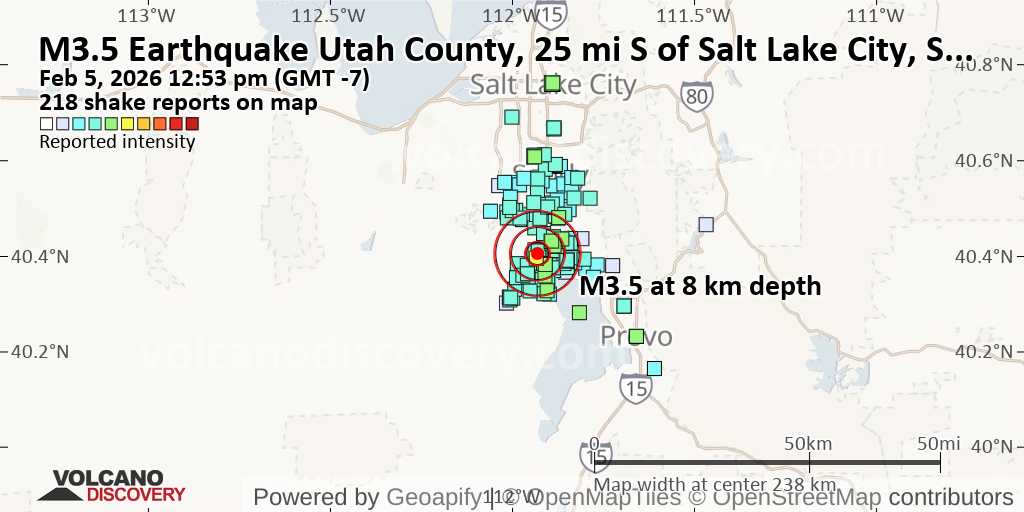
Volcano Discovery provided technical details about the earthquake, including its depth, location, and estimated shaking intensity. The report situates the Utah event within global seismic monitoring, showing how even minor earthquakes are logged and analyzed. This perspective underscores how local tremors contribute to broader datasets used by scientists to assess seismic patterns over time.
Summary / Insights
Together, the coverage shows a consistent message: small earthquakes in Utah are common, closely monitored, and generally not cause for alarm. Media reports balance public curiosity with expert reassurance, while also reinforcing the importance of long-term earthquake preparedness. The current discussion reflects ongoing public interest in understanding seismic risk in a growing region built near active faults.
TL;DR
A light earthquake near Saratoga Springs was widely felt but caused no damage. Coverage explains that such events are typical in Utah and mainly serve as reminders of long-term seismic risk.