Voyager 1’s Quiet March Beyond the Sun Is Back in the Spotlight
Nearly five decades after launch, Voyager 1 has returned to the center of scientific conversation. New reporting has revived attention on where the spacecraft is now, what boundary it has crossed, and why its slow, steady progress still matters to people on Earth. The current wave of coverage blends hard astrophysics with long-range reflection, turning an aging probe into a symbol of humanity’s longest experiment.
Main Topic Overview
Voyager 1 was launched in 1977 with a primary mission measured in years, not generations. Yet it continues to transmit data from regions no human-made object had ever reached before. What’s trending now is not a single dramatic maneuver, but a convergence of milestones: its position relative to the heliopause, its immense distance measured in light-days, and renewed discussion about its eventual journey toward another star system.
This isn’t the first time Voyager 1 has captured public attention. In 2012, NASA confirmed it had entered interstellar space, crossing the heliopause where the Sun’s influence yields to the interstellar medium. Today’s discussion builds on that moment, asking what it means to keep listening as the signal grows weaker and the distance grows almost abstract.
News Coverage
Voyager and the heliopause: Exploring where the Sun gives way to the stars
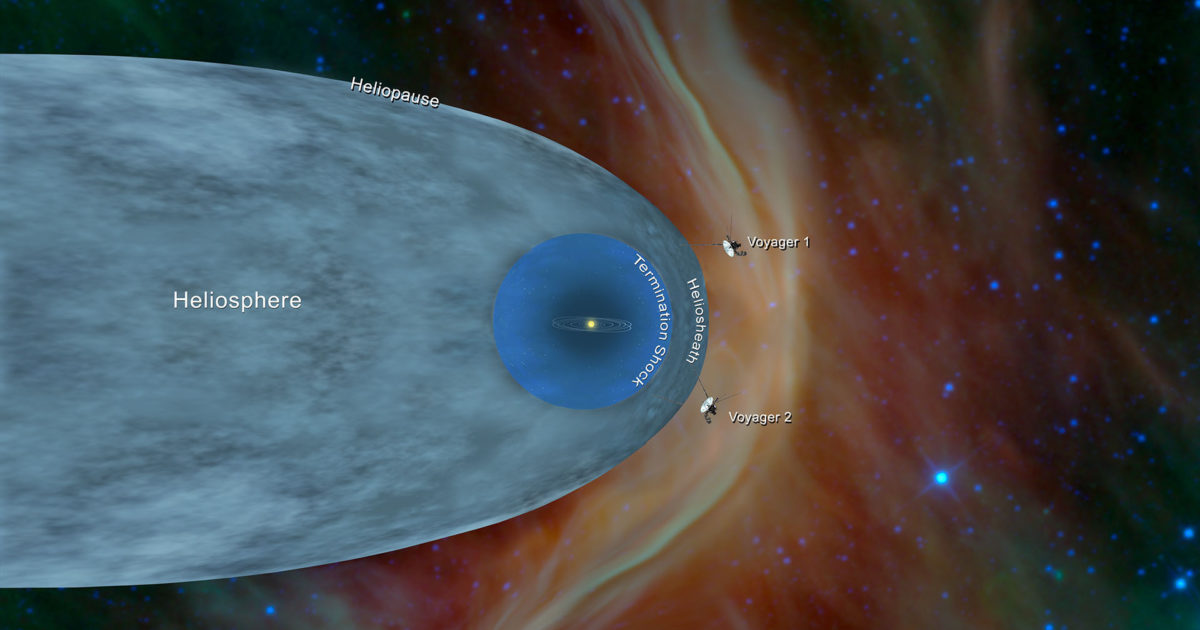
This piece revisits the heliopause not as a sharp line, but as a complex transition zone. It explains how Voyager 1’s instruments continue to detect changes in particle density and magnetic fields long after the initial crossing. Rather than framing the mission as ‘completed,’ the article emphasizes that the most valuable science is happening now, in sustained observation. The broader trend here is patience: decades of consistent data revealing how our solar neighborhood interacts with the galaxy beyond.
Voyager spacecraft on verge of passing major space milestone after nearly years

This report focuses on distance as a milestone, describing Voyager 1 approaching the span of a full light-day from Earth. While such measurements are symbolic rather than operational, the coverage shows how abstract units help the public grasp scale. The analysis ties this moment to earlier benchmarks, like passing 10 billion miles, showing a recurring pattern: Voyager’s relevance spikes whenever human language struggles to keep up with cosmic distance.
Humans might have left Earth by the time Voyager-I reaches another Solar System

This article takes a longer, more speculative view, contrasting Voyager 1’s steady trajectory with the uncertain future of human civilization. While grounded in basic astrophysical timelines, it frames Voyager as a time capsule rather than an active mission. Within the broader trend, this perspective highlights how Voyager stories often drift from engineering into philosophy, using the probe as a reference point for thinking about humanity’s longevity.
Summary / Insights
Taken together, the coverage shows why Voyager 1 keeps resurfacing in public discourse. Each update blends measurable science with human interpretation, whether through boundaries like the heliopause, milestones of distance, or reflections on deep time. The underlying narrative is continuity: a spacecraft built in the 1970s still shaping how we understand our place in the universe. As long as Voyager 1 transmits data, it remains both a scientific instrument and a cultural mirror.
TL;DR
Voyager 1 is trending again because new reporting connects its current position, scientific data, and long-term journey into a single story about exploration that never really ends.